Posts

Showing posts with the label Agalychnis lemur

Let's do some #TinyFrog :)

Image
 Starting this off with a baby Panamanian Lemur Leaf Frog (# Agalychnis lemur ) a critically endangered species. #TooCute #AmphibiousAF #FroggyAF #Frog #Frogs #Frogger #Froggy #FrogsOfInstagram #LeafFrog #LeafFrogs #TreeFrog #TreeFrogs #FrogLife #Crypsis #Mimicry #AmphibianFound #FrogsNeedOurHelp via Instagram https://www.instagram.com/p/BtRX8SpnOXy/

Adorable young Lemur Leaf Frog

Image
Lemur Leaf Frogs , Agalychnis lemur , like this young froglet pictured here, are completely adorable. We have worked with both Panamanian and Costa Rican lineages of these incredible animals. Lemur Leaf Frogs, like most phyllomedusines lay their eggs on leaves over water. Once the eggs hatch, the tadpoles plop right into the water below. It has been long known that these developing embryos have the ability to hatch early if they detect that they are in danger (from predatory wasps for example) but recent research on Red-Eyed Leaf Frogs (a relative of A. lemur ) has been investigating the mechanism by which these developing animals are able to make life decisions at such an early age. Truly fascinating work by  Karen Warkentin at Boston University . Lemur Leaf Frogs are also #CriticallyEndangered, meaning that their already dangerously low numbers are still declining in the wild. Organizations like #CRARC and #TheVivarium at the #ManchesterMuseum are working hard to save...

Critically Endangered Lemur Leaf Frog, #Agalychnis lemur today in the #frogPOD.

Image
Lemur Leaf Frogs have disappeared throughout most of their range in Costa Rica and Panama - mostly due to the devastating emergent infectious amphibian disease - #chytridiomycosis (chytrid) We have bred hundreds of Panamanian Lemur Leaf Frogs in our frogPOD, and donated over 400 of them to institutions and amphibian conservation programs. This highlights the importance of captive breeding programs to keep species alive until they can be once again safe in the wild. Plus, look how cute they are #Agalychnislemur #Phyllomedusinae #AmphibianConservation #AmphibianConservationProgram #FrogsNeedOurHelp #AtlantaBotanicalGardenConservation #EndangeredSpecies #AtlantaBG #FrogsOfInstagram #frogs #frog #salamanders #salamander #ribbit #CaptiveBreeding #CaptiveBred #ExSitu #InSitu #CaptiveAssuranceColony via Instagram http://ift.tt/29tYQGb

Just stare at these #CriticallyEndangered Lemur #LeafFrogs until it looks like a two-eyed monster!

Image
 I shot this image today in the #frogPOD 'after dark' when most of the frogs has woken up. This is just the reflection of the frog off the side of the enclosure, but it have the image quite an interesting affect. #Agalychnis #Agalychnislemur #Phyllomedusinae #AmphibianConservation #AmphibianConservationProgram #FrogsNeedOurHelp #AtlantaBotanicalGardenConservation #EndangeredSpecies #AtlantaBG #FrogsOfInstagram #frogs #frog #LeafFrog #ribbit #CaptiveBreeding #CaptiveBred #ExSitu #InSitu #CaptiveAssuranceColony via Instagram https://ift.tt/29wvHjf

Initiative 1; Part 3 | The #frogLAB

Image
  This is where we work with non-Panamanian species of frogs from Central and South America. If you saw the post from two days ago, you saw that our central Panama frogs are housed in isolation on the #FrogPOD It was hard to get a shot of all the enclosures, so I focused on these four. In these we keep Leaf Frogs (subfamily: #Phyllomedusinae ) Cruziohyla calcarifer, the Splendid Leaf Frog; C. craspedopus, the Fringed Leaf Frog; Agalychnis moreletii, the Black-eyed Leaf Frog and Agalychnis spurelli, the Gliding Leaf Frog as well as two species of Glass Frog (family: #Centrolenidae ) Sachatamia albomaculata, the White-spotted Glass Frog and Cochranella granulosa, the Granular Glass Frog. Also in this room are other phyllomedusines such as Blue-sided Leaf Frog, Agalychnis annae; Red-eyed Leaf Frog, A. callidryas; Lemur Leaf Frog, Agalychnis lemur. We also have several morphs of Dendrobates tinctorius that we breed for research, exhibits and outreach - donating many of them to vari...

Lemur Leaf Frogs, the frogPOD and our Amphibian Conservation Program featured on National Geographic's Instagram feed!

Photo by @joelsartore | The Lemur Leaf Frog is a critically endangered species that historically occurred in Costa Rica, south through Panama into Colombia. They have suffered an estimated 80% loss of population in the last fifteen years and are still in decline. The Lemur Leaf Frog pictured here was bred in captivity from frogs collected in central Panama (El Valle de Antón) during a 2005 expedition to the region. This was part of a collaborative effort by @atlbotanical @zooatl and El Valle Amphibian Conservation Center to rescue amphibian populations from the emergent infectious disease — chytridiomycosis. This fungus, nicknamed 'chytrid' devastated 85% of the Panamanian amphibians from the area. That was ten years ago, and the Lemur Leaf Frogs collected as well as other Panamanian species are housed in the #frogPOD — a biosecure facility at the Atlanta Botanical Garden where the frogs can be studied, and bred in captivity. In critical situations like this, frogs are k...

Critically endangered Lemur Leaf Frog, Agalychnis lemur

Image

Monkey and Leaf Frogs of the sub-family Phyllomedusinae; one of the most beautiful and interesting groups of frogs

Image
A composite of different species within the sub-family Phyllomedusinae; family: Hylidae. The Leaf Frogs (genera: Agalychnis and Cruziohyla ) are so named from their incredible coloration and camouflage (sometimes bordering mimicry) as well as their reproductive behavior of laying eggs on leaves above water. Monkey Frogs (genus: Phyllomedusa typically have reduced webbing on the hands and feet and rather than jumping, seem to prefer climbing, with slow deliberate movements. You can find frogs of all these genera on exhibit in the Fuqua Conservatory lobby

Critically endangered Lemur Leaf Frog from Panama, Agalychnis lemur

Image
via Instagram https://ift.tt/1vcBMpa

Agalychnis lemur, the Lemur Leaf Frog in amplexus in the frogPOD

Image
via Instagram https://ift.tt/17jSGr4

Lemur Leaf Frogs legs are quite thin - but so strong!

Image
It's a little difficult to see what's going on here, but there is a pair of Lemur Leaf Frogs (Agalychnis lemur) in amplexus in the frogPOD. They are both dangling from a leaf ...held up by one of the female's hind legs!

Agalychnis lemur and Cochranella granulosa on exhibit in the Conservatory lobby

Image
via Instagram https://ift.tt/142KrxA

Happy Holidays from the Garden's Amphibian Conservation Team

Image
via Instagram https://ift.tt/1AreRpy

Lemur Leaf frogs Hatching in the frogPOD

Image

Eggs from critically endangered Agalychnis lemur, the Lemur Leaf Frog from Panama

Image
via Instagram https://ift.tt/1v7kKrN

New Documentary will feature the Garden's frogPOD

Image
Louie Psihoyos, documentary film-maker who was awarded an Oscar (best documentary) for his film 'The Cove', is completing a new documentary on the global endangered species crisis. Louie's own personal concerns for the environment are reflected in his film topics and in the founding of the Oceanic Preservation Society. The Cove brought awareness to the continued slaughter of dolphins in Taitzi Bay, which is estimated at over 20,000 dolphin/year. His next documentary will highlight the imperiled species from around the world. The amphibian component will feature our Amphibian Conservation Program and was filmed in the frogPOD. The frogPOD houses, in isolation from other amphibians, one of the rarest assemblages of amphibians — all rescued from a chytrid fungus outbreak in Central Panama in 2005. Not the most spacious of places to film, but it worked. I will be sure to post when the movie is released. Here are some pictures from the filming. Joel Sartore, Nation Geogr...

Our Amphibian Conservation Program featured in Friday's AJC!!

Image
Elizabeth Montgomery from the AJC wrote a very nice piece on our Amphibian Conservation Program. Images and captions on the link below. Thanks, Elizabeth! Photos: The frogs at Atlanta Botanical Garden

Replanting the Colombia and Costa Rica Exhibits

Image
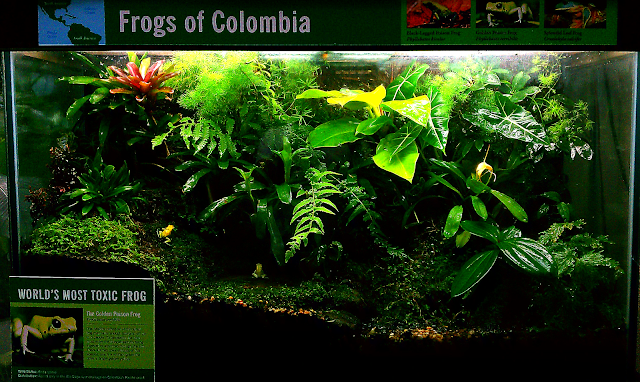
The Frogs of Colombia exhibit, with some of the plants replaced with endemic plants from the Fuqua Orchid Center. This is a project between me, Becky Brinkman (Orchid Center Manager) and Chris Miller, a new volunteer here and accomplished amphibian exhibit designer. Triolena and a Masdevallia orchid. The orchid is a hybrid as is the Phyllobates terribilis x P. bicolor next to it Phyllobates terribilis and a flowering Masdevallia A cheerful expression on this Phyllobates All three Phyllobates variations on exhibit: Phyllobates terribilis (mint), P. bicolor and P. terribilis (gold) Phyllobates often find a nice perch to claim The Costa Rica exhibit. If you look closely, you can spot at least 2 Agalychnis lemur , the critically endangered Lemur Leaf Frog Agalychnis lemur , with the new Microgamma above his right shoulder A Lemur Frog peeking out behind a new Masdevallia Dendrobates auratus is one of the shyer frogs we have on exhibit...

Exhibit Update ...

Image
One of our new exhibit animals ( Dendrobates tinctorius azureus ) donated by the Georgia Aquarium   These beautiful frogs are getting used to their new habitat in the Fuqua Conservatory lobby Weekend visitors looking for frogs after I told them there were 17 frogs and 4 tadpoles in this Costa Rica exhibit. There is a newly metamorphosed Lemur froglet in the center of the image. There are 11 critically endangered Lemur frogs ( Agalychnis lemur ) in the Costa Rica exhibit. Two of them (pictured above) are metamorphs, meaning they were recently tadpoles. Lemur frogs sleep under leaves — you can see how they would be impossible to find from the front of the exhibit. Here is a video of two of our adult Lemur frogs, in amplexus on exhibit. If you watch and listen closely, you can here the male (the one on her back) calling!

Exhibit update

Image
Lemur frogs ( Agalychnis lemur ) , when you are lucky enough to see one awake, are quite charismatic The Lemur frog s have been calling and showing other signs of an interest in breeding on exhibit! Here is a pair in amplexus. Leslie Phillips examining a Glass frog and Lemur frog sharing the same leaf. Green Spiny Toads have become an attraction in the Panama exhibit