Posts

Showing posts with the label ask the frog staff

Ask the Frog Staff: How can I donate directly to the Amphibian Conservation Program?

Today, I was asked how one can support the Amphibian Conservation Program through donations.  On the Garden's main website, there is a link for just that! If you are interested in donating, the money goes directly towards caring for our amphibian collections or supporting conservation research efforts. You can also let us know if there is a specific project you are interested in supporting. Thank you for your consideration! Here is the link: http://atlantabotanicalgarden.org/node/99

Ask the Frog Staff: Making your backyard 'amphibian friendly'

Image
I have been receiving more frequent questions about making one's backyard more amphibian friendly ... that is great! I thought I would post some ideas here. There are many compelling reasons to make your backyard 'amphibian friendly' ... one, is that natural ecotones provide refugia, or safe places for amphibians and are even easier to maintain than a well manicured lawn. There are natural and exciting ways to manage your property, that can provide much needed habitat for amphibians, particularly in an urban environment such as Atlanta. Your backyard could not only provide sanctuary for amphibians, but if enough people do the same the amphibian communities can be connected once again as they were before becoming disconnected or fragmented , by the development of roads, malls, and other forms of large paved structures. Here is a resource from the GA DNR: Georgia Wildlife website: Attracting Amphibians to Your Backyard Frogs, toads and some salamanders can be easily a...

Amphibian Conservation video with FrogPOD footage

Image

Rabb's Fringe-limbed tree frog update

Image
A recent picture of our Rabb's Fringe-limbed tree frog. Currently believed to be the last of the species. Since he was featured in the July issue of National Geographic , I have heard from an overwhelming amount of concerned people regarding this frog. I am grateful to Joel Sartore and National Geographic magazine for getting his story out there, but the truth is this species in not in a unique situation. Many amphibian species are currently threatened with extinction worldwide (Recent research suggests that more than one third of amphibian species are declining). The reasons for this are various and are most likely working in concert towards amphibian population declines. I thought I would mention that as of today, our last Rabb's Fringe-limbe tree frog is doing well. He is holding his weight and eating. He likes to sit in his tree hole and take it easy most of the time, and we try not to bother him too much. Recently, I had a request for some higher reso...

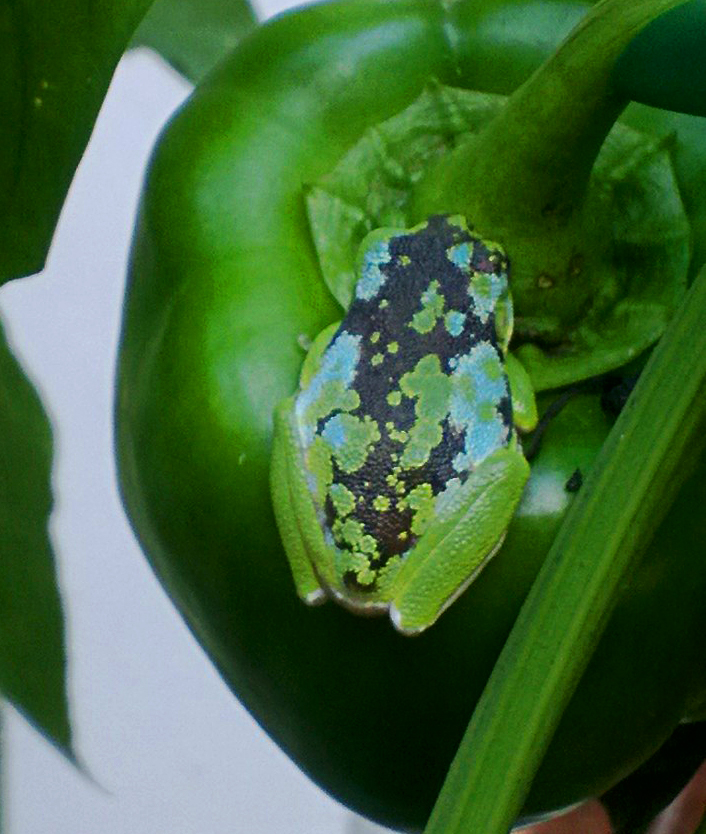
Beautiful, aberrant Barking Treefrog (Hyla gratiosa) from Lamar County

Image
Last week, I was asked to identify a remarkable frog that a resident of Lamar County found in her garden. (see pictures below) Although this frog is uniquely hyper-melanistic and axanthic (lacking yellow pigment) in places (exposing the blue structural color), it is clearly identifiable as Hyla gratiosa by its size, shape, granular skin and dorsal pattern. Photos by Jennifer Willis of Barnesville, GA September 9th update ... this frog (and photos) were featured in the latest GA DNR bulletin, with a quote from UGA Biologist and Professor Dr. John Maerz ... What frog is that?  Jennifer Willis of Barnesville photographed this odd-looking amphibian  (left)  on a green pepper in her garden Aug. 19. Although it’s a  barking treefrog  – common across most of the state –  Dr. John Maerz  of UGA’s  Warnell School of Forestry and Natural Resources  said the uncommon coloring is from a skin mutation. Maerz writes that  amphibian s...

Ask the frog staff: Parental Care in Poison frogs

Image
Excuse me, i've got a question about dendrobatidae : Is Dendrobates Pumilio the only species whose females carry tadpoles on their backs, or not ? Thanks (Ivan L) Epipedobates tricolor transporting tadpoles across the conservatory to a suitable water source Thanks, Ivan ... Dendrobates pumilio (now Oophaga pumilio ) like most frogs in the dendrobatidae family transport their larvae to a suitable aquatic environment after hatching. Often times, it is the female but sometimes it can be the male. If I remember correctly, larvae can be transported by either in O. pumilio , but most often it is the female ... Thanks for your question! I find parental care in frogs—and particularly Poison frogs— fascinating — Mark

Ask the frog staff: How many tadpoles actually survive into adulthood?

Image
Hi Mark. A frog friend and I were at the lily pond today and it was rife with tadpoles of various sizes and stages. Two questions: 1) It looked like the two ducks might be feeding on them ... do they? 2) How many tadpoles actually survive to frog adulthood? — Christine C. This particular topic has come up a lot recently, and one of our visitors beautifully photographed a heron eating a rather large bullfrog out of the lily pond in the Children's Garden . It was a graphic interaction, but demonstrates how vital amphibians are in food webs and one of the reasons we use to illustrate how important it is to keep amphibians around. Almost everything eats them, or their tadpoles, or their eggs ... or all three.  Many animals eat frogs exclusively (including some frog species!), and the herons at the Garden obviously love them. I have seen ducks eating tadpoles quite rapidly. In fact, my amphibian class last summer quantified how quickly different aquatic birds could ...

Ask the Frog Staff | What do frogs do in the winter?

Image
'What do frogs do in the winter?' "Was visiting yesterday and strolled past both the "Frog Baby" pond and  the lily pond.  Where do the frogs go in the winter?  Thank you."  -  Christine C. Thank you for your question! The answer to which I find particularly fascinating. Frogs do several different things to handle freezing temperatures in the winter. Those bullfrogs in the Garden ponds ... do just what they and other frogs do in the winter which is brumate . Brumation is like hibernation, only metabolically it is a much different process utilized by cold blooded animals. Leopard frogs and Green frogs are other examples of frogs that brumate. They simply burrow, dig or hide deep enough below the frost line where they won't actually be exposed to freezing (or below) temperatures. Other frogs (at least up and down the East Coast) actually posses the biological equivalent of antifreeze in their cells so freezing temperatures ar...