Posts

Showing posts with the label Gastrotheca cornuta

Captive Assurance Colonies

Image
A few people recently have asked about the kind of research we do in the Amphibian Conservation Program @ ABG, so I thought I would answer in pictures. There are five major components of our program, but our first priority, and the reason the program started in the first place was to build and maintain #CaptiveAssuranceColonies of rare and endangered amphibians from the #neotropics and SE US. Initiative 1: Historically, we have worked with imperiled amphibian species from Costa Rica, Ecuador, Suriname, Chile and Panama and have been the first to breed many species of #GlassFrog ( #Centrolenidae ), Eyelash Marsupial Frog (#Gastrotheca), Pratt's Rocket Frog #Colostethus , Gaige's Rain Frog #Pristimantis , and one of the first to breed #Cruziohyla in captivity. One of our largest conservation efforts was our collaborative expedition to Panama in 2005 to rescue frogs from the emergent infectious disease - #chytrid (chytridiomycosis). This fungus attacks amphibians world wide and b...

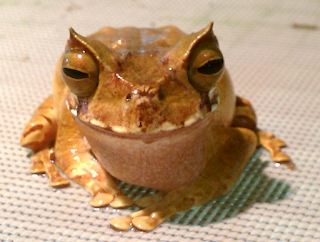
Gastrotheca cornuta, the Eyelash Marsupial Frog from Panama

Image
via Instagram http://ift.tt/1vDbs5t

Our amphibian program featured on the Manchester Museum's 'frog blog'

Image
Andrew Gray, a collaborator and friend with our Amphibian Conservation Program took this shot of the Eyelash Marsupial Frog ( Gastrotheca cornuta ) sculpted in plants (mosaiculture) The Atlanta skyline in back ... Andrew Gray , from the Manchester Museum visited a few weeks ago. Andrew's amphibian conservation collection at the museum features one of the most interesting groups of frogs there is — the Phyllomedusines (Leaf and Monkey Frogs). His program was featured on Sir David Attenborough's most recent (and excellent) frog documentary 'Fantastic Frogs'. Be sure to check it out when you can. Andrew highlighted his visit on the Manchester Museum's 'frog blog' including some pictures below. Here is a link to the article: http://frogblogmanchester.com/2014/07/06/15364/ My goofy mug, and also a cool Hippo Frog ( Lepidobatrachus ) coffee mug

New Documentary will feature the Garden's frogPOD

Image
Louie Psihoyos, documentary film-maker who was awarded an Oscar (best documentary) for his film 'The Cove', is completing a new documentary on the global endangered species crisis. Louie's own personal concerns for the environment are reflected in his film topics and in the founding of the Oceanic Preservation Society. The Cove brought awareness to the continued slaughter of dolphins in Taitzi Bay, which is estimated at over 20,000 dolphin/year. His next documentary will highlight the imperiled species from around the world. The amphibian component will feature our Amphibian Conservation Program and was filmed in the frogPOD. The frogPOD houses, in isolation from other amphibians, one of the rarest assemblages of amphibians — all rescued from a chytrid fungus outbreak in Central Panama in 2005. Not the most spacious of places to film, but it worked. I will be sure to post when the movie is released. Here are some pictures from the filming. Joel Sartore, Nation Geogr...

Species Spotlight: Eyelash Marsupial Frogs

Image
Eyelash Marsupial Frog | Gastrotheca cornuta . Vito Corleone shot Eyelash Marsupial Frog |  Gastrotheca cornuta in the frogPOD Male  Eyelash Marsupial Frog |  Gastrotheca cornuta . Female  Eyelash Marsupial Frog |  Gastrotheca cornuta . Notice the opening of the  'marsupial' pouch on the back of the females.

Kelsey Jordan Exit Show, featuring frogs from our Conservation Collection!

Image
Kelsey Jordan , an intern in the Garden's Department of Conservation Research and student at the University of Georgia held her exit show this past Monday at  The Lamar Dodd School of Art . Kelsey is completing the scientific illustration program at UGA and her exhibit featured water color paintings as well as pencil sketches of frog species from the Atlanta Botanical Garden's amphibian conservation program. Her work highlights the unique parental care adaptations of the frog species she selected. Kelsey and I on either side of her  Rhinoderma  painting. Darwin's frogs exhibit one of the more bizarre strategies of parental care. As illustrated here, froglets emerge post-development from the mouth of their father! In this species, a male will snatch up the larvae in his mouth as they hatch. He protects them in his vocal sac until development is complete. I had the privilege of working with her at the onset of her thesis, and was amazed at her preliminary sketche...

It's great to be back!

Image
It has been a busy summer here in the amphibian program. For me, it was hard to be gone for the entire month of June, and then again for another week last week at IHS. The Costa Rica exhibit. This picture illustrates the differential leaf side preference of the two resident species of Tree frog. Lemur frogs typically sleep on the underside of leaves, whereas glass frogs will stick to the tops. Here are some recent pictures of some of the frogs I missed so much while I was gone, many of which are currently in breeding groups for the summer... Incilius conifera (Bufo conifera) | Green spiny toad in the Panama exhibit Splendid leaf frog | Cruziohyla calcarifer in the Colombia exhibit. One of our newest additions, the Green and black poison frog | Dendrobates auratus The Green and black poison frogs were shy at first, but now you can usually see at least a few of the five at any point in the day. Here they are in a 'coconut hut' placed in there to enco...

Georgia Public Broadcasting episode featuring the amphibians of GA, ABG and Robert Hill

This weekend at the Garden ...

Image
As things continue to warm up here in Atlanta, even the neotropical frogs in our captive breeding program are responding to the warmer temperatures and longer daylight hours. With all this increased activity, I was happy to have my camera with me ... I was even able to record one of our male Gastrotheca cornuta  (Horned marsupial frogs) calling! One of four calling male Gastrotheca in the frogPOD yesterday Epipedobates spp. — a possible hybrid in the Rotunda.  Pictured above is a poison frog in the Conservatory. Edward and I have had our eyes on this one for several weeks now, and we think it is possibly a hybrid between the 2 Epipedobates species living in the 'Gardens Under Glass'. E. tricolor (Phantasmal poison frog) is brown with bright green stripes on the flanks and green dorsum, whereas E. anthonyi (no common name) is burgundy red with 3 baby blue stripes down the back. The frog pictured above appears to be a 'washed out' burgundy red with ...

a frog in the pod

Image
Gastrotheca cornuta , the Horned marsupial frog, in the frogPOD at Atlanta Botanical Garden .  Gastrotheca cornuta This critically endangered species was first bred in captivity here at the Garden. One component of the research we do in the Department of Research and Conservation is simply learning how to keep these, and other endangered frog species alive, healthy and breeding. Gastrotheca cornuta No two frog species have the exact same care requirements, and the advancements we make here with our conservation collection are shared with institutions and individuals around the world, including the regions where frogs are particularly threatened.

Marsupial Frogs

Image
Marsupial frogs are amazing animals. When breeding, the male will fertilize the eggs and aid in placing them in the female's brooding pouch on her back. Most frogs will lay their eggs in the water where they will develop without the help or protection of either parent, but the female Marsupial frog will carry her young in her pouch until they are ready to emerge as tiny froglets. Female Marsupial frog We have 2 of these beautiful frogs on display in our ' Frogs of Panama ' exhibit, and both of them were born here in our frogPOD! Currently, in our frogPOD, there is a female brooding another clutch of eggs. We are all waiting patiently and not disturbing her for the three months it takes for them to develop. We will keep you posted and hopefully soon, we will have new Marsupial froglets of this endangered species!