Posts

Showing posts with the label video

Great and Recent Footage of Gopher Frogs calling at Sandhills WMA

Recently, Erin Cork of UGA and colleagues recorded this wonderful video which captures the lovely snoring calls of Georgia's rarest frog — The Gopher Frog ( Lithobates capito ) . There are at least 2 other species of frog in the background as well — can you tell what they are?? Survey frequencies and scope have increased this year in response to the continued decline of the species throughout the state. Sandhills WMA for example, is one of the source ponds of eggs for the now decade-long Head Start program, where eggs are collected and reared past the sensitive tadpole stage and released into protected habitat as froglets. In recent years, however, detections have declined, and this is the main reason that the Amphibian Foundation, in partnership with Zoo Atlanta, GA DNR, UGA and USFWS have begun establishing a captive propagation program. If we can produce healthy baby Gopher Frogs at the Foundation, then we don't have to rely on wild collected eggs for the conserva...

A great article with footage of Leaf Frog embryos escaping from predators

This link was submitted by Amphibian Conservation Program supporter Bob Mohl ... thanks!!

The life of Urban Frogs | CICI BLUMSTEIN | TEDxBrighton

Image
Frog Collaborator & Artist CiCi Blumstein  aka Agent Amphibian discusses the plight of the urban amphibian, and includes a discussion of the Rabbs' Fringe-Limbed Treefrog which resides here at the Garden, and is believed to be the last one in existence.

The Garden and our Amphibians featured on China's World Traveler website

Amphibian Conservation video with FrogPOD footage

Image

Amphibian Feeding Mechanics Class at the Garden

Image
This semester, the Garden's Department of Research and Conservation collaborated with GA Tech's School of Biology to offer a research course in aspects of  functional morphology . As one of my favorite subjects of all time, functional morphology — or biomechanics  — investigates animal movements (often with the help of x-ray and/or high-speed videography) to gain a better understanding of how animals successfully project their tongues, locomote, capture prey, swim, burrow or practically anything one can measure and sequence. The Biomechanics of Amphibian Feeding class of 2014 . From the top left: Alison Burger, Allison Miles, Emily Stephens, Rachel Whitmire, Courtney Pettiford, Erin Gish. Middle left: Paul Sanders, Leslie Phillips (Garden Teaching Assistant), Alexis Noel (GA Tech Teaching Assistant) Courtnae Ramser, Anna Morocco, Blake Christianson. Front Row: Instructors Dr David Hu and Mark Mandica The class was offered to 10 graduating seniors at GA Tech and the pu...

The Wood Frog eggs (Lithobates sylvaticus) a few days later!

Image
The next video shows the developing Wood Frog embryos (almost tadpoles!) inside of the eggs. Trying out movement for the first time. Thanks again to Tracy Hicks for supplying this video!

Glass Frogs and our Amphibian Conservation Program featured on 'Unusual Creatures' PBS Digital Studios

Image

A Wonderful documentary exploring a year in an ephemeral wetland: Metamorphosis: Amphibian Nature Documentary

Image

Ambystoma bishopi, Reticulated Flatwoods Salamander feeding

Image
The Reticulated Flatwoods Salamander , Ambystoma bishopi is one of the most imperiled amphibian species in the US. Gone from Georgia and Alabama, A. bishopi is now restricted to a handful of puddles in Northern Florida. The Garden is working with USFW as well as biologists from VA Tech, to attempt to breed this species in captivity to boost population numbers in the wild. This video (shot by Leslie Phillips, Amphibian Specialist @ ABG) shows a recent metamorph feasting on an earthworm. To see more of the work on this species, click here .

Amphibians and Reptiles of Georgia audio supplement (playlist)

Image
An audio supplement to the comprehensive book 'Amphibians and Reptiles of Georgia' ...

Exhibit Update ...

Image
One of our new exhibit animals ( Dendrobates tinctorius azureus ) donated by the Georgia Aquarium   These beautiful frogs are getting used to their new habitat in the Fuqua Conservatory lobby Weekend visitors looking for frogs after I told them there were 17 frogs and 4 tadpoles in this Costa Rica exhibit. There is a newly metamorphosed Lemur froglet in the center of the image. There are 11 critically endangered Lemur frogs ( Agalychnis lemur ) in the Costa Rica exhibit. Two of them (pictured above) are metamorphs, meaning they were recently tadpoles. Lemur frogs sleep under leaves — you can see how they would be impossible to find from the front of the exhibit. Here is a video of two of our adult Lemur frogs, in amplexus on exhibit. If you watch and listen closely, you can here the male (the one on her back) calling!

Did this frog even wake up?

I am trying to count how many things this frog can do simultaneously including sleep. The spectacular Fringed leaf frog | Cruziohyla craspedopus  are canopy frogs from the Amazon, which rarely (if ever) even come down from the tree tops. They will make their public debut in our new exhibit coming mid-January. I love how she grasps the cricket in her hand and stuffs it in her mouth ... a behavior this species shares with the other Cruziohyla — calcarifer .

Georgia Public Broadcasting episode featuring the amphibians of GA, ABG and Robert Hill

Dante and One of our Garden Bullfrogs

Image
The Aquatic Plants pond at The Garden Dante Fenolio, Amphibian Conservation Scientist here at the Garden, might also be called "The Frog Whisperer' as he dazzled visitors this Sunday with his skill at calling a male Bullfrog | Lithobates catesbeianus over to him from the aquatic plants pond. Seeing is believing! After he came over to Dante, Garden visitors were holding the friendly frog for photo opps. The Bullfrog climbed right up on Dante's hand! Here he is approaching us Dante's daughter, Sierra bravely holding the large frog for pictures Sierra is very happy holding the large bullfrog After the photos were taken, one of the visitors released him back into his pond

Eleutherodactylus johnstonei | Whisting tree frog calling

As mentioned in the previous post, there was a low pressure system moving through central Georgia this weekend and the frogs responded. I was delighted to see and hear all 3 species of Eleutherodactylus (direct developing) frogs in the conservatory today: the Coqui | Eleutherodactylus coqui , the Whistling tree frog | E. johnstonei and the Greenhouse frog | E. planirostis . Here is a video clip of a Whistling tree frog calling in the conservatory. Frogs of the genus Eleutherodactylus are direct developing, which means they do not have a free swimming larval stage (tadpole) as most frogs do. Eggs are laid in moist places such as bromeliad axils and tiny frogs emerge from the eggs once development is complete.

"Ranita de Darwin" Zoológico Nacional

Image

The Thin Green Line — PBS.org video on amphibian declines

Image
(with a segment featuring our ABG Amphibian Conservation Program and Robert Hill!) Video: Full Episode

This weekend at the Garden ...

Image
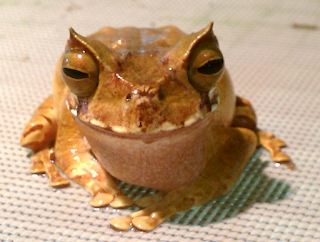
As things continue to warm up here in Atlanta, even the neotropical frogs in our captive breeding program are responding to the warmer temperatures and longer daylight hours. With all this increased activity, I was happy to have my camera with me ... I was even able to record one of our male Gastrotheca cornuta  (Horned marsupial frogs) calling! One of four calling male Gastrotheca in the frogPOD yesterday Epipedobates spp. — a possible hybrid in the Rotunda.  Pictured above is a poison frog in the Conservatory. Edward and I have had our eyes on this one for several weeks now, and we think it is possibly a hybrid between the 2 Epipedobates species living in the 'Gardens Under Glass'. E. tricolor (Phantasmal poison frog) is brown with bright green stripes on the flanks and green dorsum, whereas E. anthonyi (no common name) is burgundy red with 3 baby blue stripes down the back. The frog pictured above appears to be a 'washed out' burgundy red with ...