Posts

Showing posts with the label exhibit design

Replanting the Colombia and Costa Rica Exhibits
Image
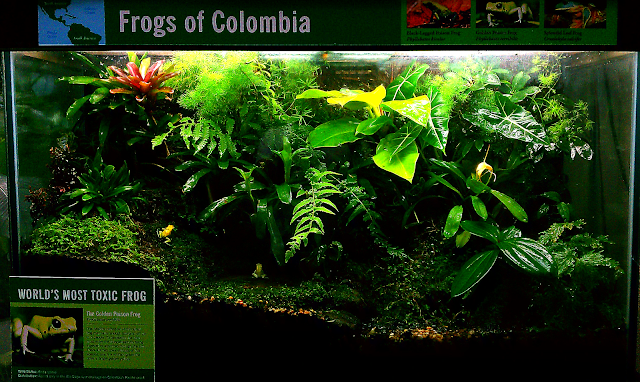
The Frogs of Colombia exhibit, with some of the plants replaced with endemic plants from the Fuqua Orchid Center. This is a project between me, Becky Brinkman (Orchid Center Manager) and Chris Miller, a new volunteer here and accomplished amphibian exhibit designer. Triolena and a Masdevallia orchid. The orchid is a hybrid as is the Phyllobates terribilis x P. bicolor next to it Phyllobates terribilis and a flowering Masdevallia A cheerful expression on this Phyllobates All three Phyllobates variations on exhibit: Phyllobates terribilis (mint), P. bicolor and P. terribilis (gold) Phyllobates often find a nice perch to claim The Costa Rica exhibit. If you look closely, you can spot at least 2 Agalychnis lemur , the critically endangered Lemur Leaf Frog Agalychnis lemur , with the new Microgamma above his right shoulder A Lemur Frog peeking out behind a new Masdevallia Dendrobates auratus is one of the shyer frogs we have on exhibit...

Amphibians on exhibit update

Image
The Granular Glass frog | Cochranella granulosa is almost always sitting out, rather cooperatively in plain view The Costa Rica exhibit - can you spot the newly emerged Lemur froglet ? A close up of the last Lemur frog metamorph from the first batch of 12 larvae put on exhibit last January!  6 new tadpoles are now inhabiting the water feature at the front of the exhibit. Here is the Lemur froglet | Agalychnis lemur , moments out of the water. Black-legged poison frog | Phyllobates bicolor , surveying the feast of wingless fruit flies before it. One of the Green and Black Poison frogs | Dendrobates auratus posing for the camera. Although there are 5 of these on display in the Costa Rica exhibit, they are not always in view The Mimic Poison frog | Ranitomeya imitator from the Amazon Exhibit One of the salamanders in the Salamanders of Georgia exhibit. This Green salamander is probably the least reclusive of the ELEVEN salamanders residin...

Fuqua Conservatory Lobby Amphibian Exhibits

Image
A conservatory at a botanical garden might be an odd place to look for amphibians, but that is exactly what you will find in the Fuqua Conservatory here at the Garden. Especially in the lobby where 6 exhibits highlighting our amphibian conservation program are located. What you will see upon entering the Conservatory from the Great Lawn.  The Frogs of Costa Rica , and beyond is the hallway to our Salamanders of Georgia exhibit, where the walls display images and information about off-exhibit amphibian species we are working with that are endangered or otherwise too sensitive to be on public display. The design and development of the triple exhibit (Panama, Amazon and Costa Rica) was my first project as Amphibian Conservation Coordinator and highlights the relationships between the endemic amphibians and plants of the regions. They have been growing in nicely since January! Opposite the Panama, Amazon and Costa Rica exhibits are Poison frogs from Suriname (left) and ...

Inside the New Exhibits | part 3 — Amazon

Image
(Continued from Part 2, Costa Rica exhibit) Cruziohyla craspedopus | Fringed leaf frog on exhibit at the Atlanta Botanical Garden The Frogs of the Amazon Basin exhibit was exciting to develop. First, it would be displaying one of the most captivating species I had ever read about — Cruziohyla craspedopus | The Fringed leaf frog . We have 2 on display right now, and those are the only two of the species on exhibit — anywhere in the world! There are only 10 individuals in the country, and all of them are here in our amphibian conservation collection, either on exhibit or in our captive breeding lab. Before working at the Garden, I had only dreamed about being in the same room with a Fringed leaf frog. Very little is known about the species due to their rarity and the fact that they live high in the tree canopy in the Amazon rainforest, never needing to come to the ground for anything. If you would like to see this species in the wild ... you have got to get way up in the tr...

Inside the New Exhibits | part 2 — Costa Rica

Image
The 'new' frog exhibits: Frogs and Plants of Panama (left), the Amazon (center) and Costa Rica (right) as they look in May 2012 (this post has been back-dated) (Continued from Part 1) I started with the  Costa Rica  exhibit — the first exhibit one sees as they approach. Dante and I decided to try three tricky (shy) species all in the same exhibit:  Glass frogs  ( Cochranella granulosa ),  Lemur frogs  ( Agalychnis lemur ) and  Green and black poison frogs  ( Dendrobates auratus ). We had never tried to display either Glass frogs or Lemur frogs before, despite having worked with both groups for many years at the Garden. I have to imagine this is because they are nocturnal and extremely shy. Glass frogs, for instance, are not only shy, but are transparent! Terrible qualities for selecting an animal to exhibit. Lemur frogs are also challenging as during the day they disappear, seemingly adhered to the underside of leaves. Even Green and bl...

Inside the New Exhibits | part 1 — plants

Image
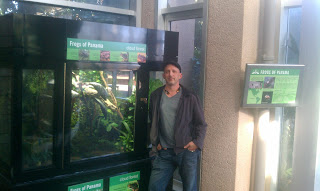
The original Frogs of Panama exhibit One of the first assignments in my new role was to design and coordinate the opening of three new frog exhibits for the Fuqua Conservatory lobby. The stand and the 3 aquaria were already being built to replace the current Frogs of the Panama Cloud Forest exhibit. This enormous terrarium (pictured with me, above) was one of the original orchid exhibits, and was showing signs it could not contain a miniature cloud forest much longer. I was delighted to hear that Robert Hill (my predecessor) and Mike Wenzel (plant records guru) had already made some headway into finding plants that would not only be accurate to the regions of which they were depicting, but might also feature plants of focus in our conservatory and conservation collections. We decided the regions we would focus on for the new exhibits would be Costa Rica , the Amazon basin, and of course a downscaled version of our previous Panama exhibit. To be honest, in previous terrariu...

Our new 'Okopipi' exhibit

Image
' Giant Orange ' morph of Dendrobates tinctorius ' Sipaliwini ' morph of D. tinctorius The ' Azureus ' morph (middle) of D. tinctorius   a tinct showdown Robert and I finally had the chance to build and exhibit together this past Monday. It seems the poison frogs in our new Okipipi exhibit are settling in nicely. They were out all day today foraging and figuring out who's spot was who's. There are many 'morphs' or variations of Dendrobates tinctorius , depending on where they occur in South America. The ' Cobalt ' morph is the predominant color variation, occurring throughout most of its range. It is also the nominate morph, meaning the species was originally described from the Cobalts (see below) The ' Cobalt ' morph of D. tinctorius