Posts

Showing posts with the label Metro Atlanta

Master Herpetologist Program Summer Field Trip: Amphibians!

Image
This weekend, we embarked on the Amphibian Field Trip with this summer semester's Master Herpetologist Program, and we did really well! Especially considering that a hot summer day in Atlanta is not typically the best conditions in which to find amphibians. For the Amphibian Field Trips, we go to Clyde Shepherd Nature Preserve in Dekalb County, which is one of my favorite places to look for amphibians in metro Atlanta. It is also a repatriation site of ours for Spotted Salamanders ( Ambsytoma maculatum ) where the data suggests we have successfully reintroduced the species, which hadn't been seen on the preserve in 20 years. Unfortunately, we didn't find any on Saturday, but the summer is a terrible time to look for them. We did, however, conduct a 2 hour field survey of the property. Future Master Herpetologist, Barb (left) and Emma a Summer Intern at AF met before the field trip to conduct a 'stream clean-up of the creek at Clyde Shepherd Nature Preserve. They r...

Garden Videos of native species

Chris Tinsley, one of the folks here at the Garden recently sent me these two cool videos of some herps around the Garden. First, there is a Bullfrog ( Lithobates catesbeianus ) calling in the pond in front of the Fuqua Orchid Center, and next and next, the detached tail of a 5 Lined Skink ( Eumeces fasciatus ) Thanks Chris for sending these along!

Baby snappers! Some of the Orme Park rescue turtles ... release party tbd

Image
via Instagram http://ift.tt/1vlvJZ4

Rescued 10 hatchling snapping turtles today in mid-town ... they have probably been stuck in their nest for a month!

Image

Ask the Frog Staff: Making your backyard 'amphibian friendly'

Image
I have been receiving more frequent questions about making one's backyard more amphibian friendly ... that is great! I thought I would post some ideas here. There are many compelling reasons to make your backyard 'amphibian friendly' ... one, is that natural ecotones provide refugia, or safe places for amphibians and are even easier to maintain than a well manicured lawn. There are natural and exciting ways to manage your property, that can provide much needed habitat for amphibians, particularly in an urban environment such as Atlanta. Your backyard could not only provide sanctuary for amphibians, but if enough people do the same the amphibian communities can be connected once again as they were before becoming disconnected or fragmented , by the development of roads, malls, and other forms of large paved structures. Here is a resource from the GA DNR: Georgia Wildlife website: Attracting Amphibians to Your Backyard Frogs, toads and some salamanders can be easily a...

MAAMP Survey Photos from Lauren @ Paces Mill

Image
Lauren Melde, Amphibian Conservation Intern and MAAMP surveyor @ Paces Mill took these great photos of species she encountered during this month's survey. Thanks Lauren! Hyla chrysoscelis , Cope's Grey Treefrog, perched on a branch. This is a male that was heard calling during the survey. Here is the Grey Treefrog from the top ... beautiful! Southern Leopard Frog, Lithobates sphenocephala

The Wood Frog eggs (Lithobates sylvaticus) a few days later!

Image
The next video shows the developing Wood Frog embryos (almost tadpoles!) inside of the eggs. Trying out movement for the first time. Thanks again to Tracy Hicks for supplying this video!

Native Species Spotlight: Lithobates sylvaticus | Wood Frog

Image
An amazing photo of a female Wood Frog by my new friend, Lisa Powers. Females are generally reddish in color, particularly during their breeding season. One of the first signs of spring — or at least the ones I look for — are the Wood Frogs. Where I am from in Massachusetts, Wood Frogs brave the ice and snow to make it to their vernal ponds to breed every year. I can recall many times when I am out at night in the spring—freezing! ... and these little frogs aren't complaining (and they can't even produce their own body heat!) — they are just making their way to the breeding site. In Georgia, the Wood Frogs are out right now, calling and laying eggs in ephemeral pools (and occasionally the edges of permanent wetlands) Wood Frogs typically lay all their eggs in one place, so if you find one clutch, you have probably found them all. When laid, they are about the size and shape of a tennis ball or baseball, but quickly swell up with water and become much larger. Here is a ...

Metro Atlanta Amphibian Monitoring Surveys begin!

Image
30 baby Spotted Salamanders ( Ambystoma maculatum ) were released in Storza Woods last year at an artificial ephemeral wetland made by amphibian conservation staff, volunteers and interns. Storza Woods is one of the many sites being monitored this field season. Pictured here is an adult female. This month, the first surveys for the Metro Atlanta Amphibian Monitoring Program began in Dekalb and Fulton Counties. Initiated by the Amphibian Conservation Program , we hope to collect data on the 17 species of frog and 14 species of salamander native to Greater Atlanta. In time, this data could provide us with vital information on the health and status of our urban amphibian communities, as well as identify potential sites for conservation and habitat restoration. Last year, amphibian conservation staff, volunteers and interns built an artificial ephemeral wetland inside of Storza Woods (the north west corner of the Garden) and released almost 30 baby Spotted Salamanders ( Ambystoma ...

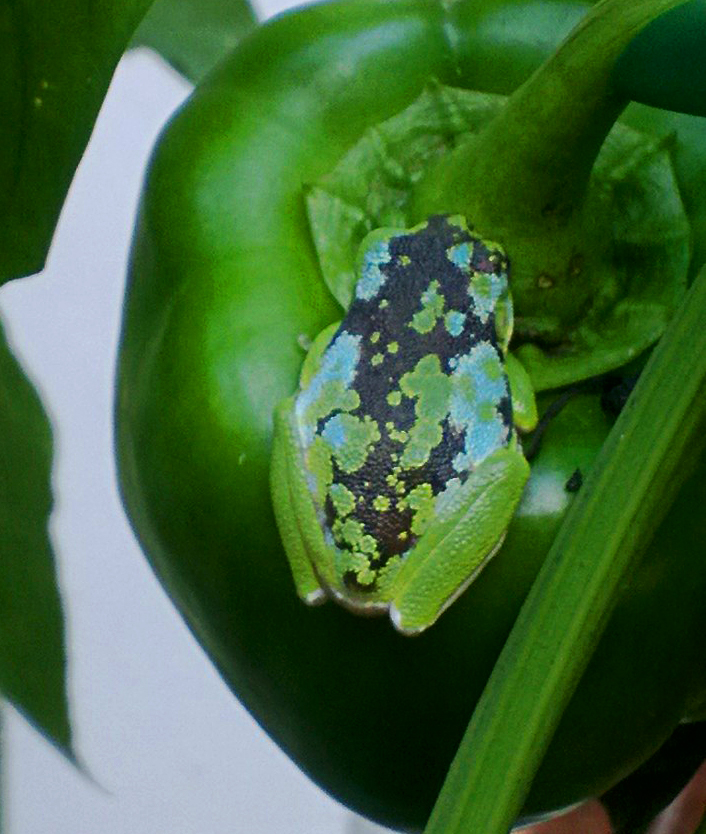
Beautiful, aberrant Barking Treefrog (Hyla gratiosa) from Lamar County

Image
Last week, I was asked to identify a remarkable frog that a resident of Lamar County found in her garden. (see pictures below) Although this frog is uniquely hyper-melanistic and axanthic (lacking yellow pigment) in places (exposing the blue structural color), it is clearly identifiable as Hyla gratiosa by its size, shape, granular skin and dorsal pattern. Photos by Jennifer Willis of Barnesville, GA September 9th update ... this frog (and photos) were featured in the latest GA DNR bulletin, with a quote from UGA Biologist and Professor Dr. John Maerz ... What frog is that?  Jennifer Willis of Barnesville photographed this odd-looking amphibian  (left)  on a green pepper in her garden Aug. 19. Although it’s a  barking treefrog  – common across most of the state –  Dr. John Maerz  of UGA’s  Warnell School of Forestry and Natural Resources  said the uncommon coloring is from a skin mutation. Maerz writes that  amphibian s...