Posts

Showing posts with the label Rhinoderma darwinii

Kelsey Jordan Exit Show, featuring frogs from our Conservation Collection!

Image
Kelsey Jordan , an intern in the Garden's Department of Conservation Research and student at the University of Georgia held her exit show this past Monday at  The Lamar Dodd School of Art . Kelsey is completing the scientific illustration program at UGA and her exhibit featured water color paintings as well as pencil sketches of frog species from the Atlanta Botanical Garden's amphibian conservation program. Her work highlights the unique parental care adaptations of the frog species she selected. Kelsey and I on either side of her  Rhinoderma  painting. Darwin's frogs exhibit one of the more bizarre strategies of parental care. As illustrated here, froglets emerge post-development from the mouth of their father! In this species, a male will snatch up the larvae in his mouth as they hatch. He protects them in his vocal sac until development is complete. I had the privilege of working with her at the onset of her thesis, and was amazed at her preliminary sketche...
Notes from the Field: Dante in Chile, Nov 2011

Image
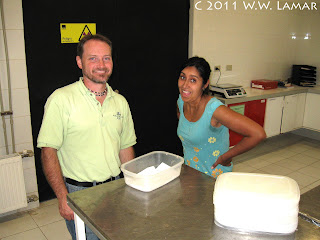
  Lead veterinarian for the National Zoo of Chile in Santiago, Marcela Tirado , and amphibian biologist for the Atlanta Botanical Garden, Danté Fenolio , prepare to process an incoming batch of live frogs going into quarantine. Skin swabs are taken from newly collected frogs as they are entered into the quarantine process at the National Zoo of Chile. Skin swabs are non-invasive and screen for a potentially lethal fungal pathogen, amphibian chytrid fungus. This Darwin's Frog ( Rhinoderma darwinii ) is tolerating a brief skin swab. Newly collected and incoming frogs pass through a quarantine process that lasts a little longer than a week.  They live in plastic boxes throughout the quarantine window.  Frog boxes are changed for sterile boxes and are given a daily soak in a solution that kills amphibian chytrid fungus.  The procedures performed ensure that frogs entering the captive breeding facility are free of amphibian chytrid fungus.

Another blog highlighting our amphibian work in Chile

Image
Bush Warriors , a Global Voice for Wildlife . published an article detailing the Garden's work with endangered frog species in Chile. Click here to read more ... a screen grab from the blog [ read the article ]

The Garden's Darwins frog conservation work highlighted by the AZA!

Image
Rhinoderma darwinii | Darwin's frog The Association of Zoos and Aquarium (AZA) published two articles this month highlighting the Darwin's frog | Rhinoderma darwinii conservation collaboration between the Atlanta Botanical Garden and the National Zoo of Chile . The first one was in their monthly magazine, Connect (see below) Also on their Blog: ZooExplorer Herpetologist Bill Lamar holding a Darwin's frog | Rhinoderma darwinii

"Ranita de Darwin" Zoológico Nacional

Image

2011 International Herpetological Symposium

Image
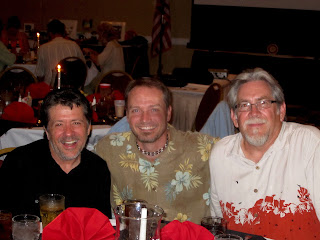
Dr. Fenolio presented a talk on the Atlanta Botanical Garden's work in Chile with Darwin's Frogs at the 2011 International Herpetological Symposium in Fort Worth, Texas.  Louie Porras (left) is a Costa Rican born herpetologist and long time friend of Fenolio.  Jim Stout (right) often times works with Fenolio in the field, including a recent trip to China and Thailand.

More great news from Chile!

Image
'To the Garden Community, A captive bred Darwin's frog is held by a researcher shortly after it was coughed up from its dad's vocal sac. Ten baby frogs were coughed up at a breeding facility in Chile on Thursday. Our little project in Chile just hit another milestone, we have male Darwin’s Frogs “coughing up” babies as you read this.  This year had a bumper crop of baby Darwin’s Frogs born and bred in the lab that we established in Santiago, Chile.  I believe that this is a moment that the Garden can be very proud of.  Darwin’s Frogs, along with many of South Chile’s amphibians, are imperiled owing to a host of anthropogenic environmental problems.  Most certainly, the international media is paying attention.  The largest newspaper in Chile is at the facility now taking pictures and doing interviews for a story.  Next week, the facility will be featured on a mainstream TV channel in Chile.  The zoo in Santiago just elected to do a series of...

Notes from the Field: Dante in Chile

Image
Rhinoderma darwinii, Darwins frog "The big news is that we have our first captive born and bred Darwin's Frogs .  An image of a baby at the tip of a gloved human fingertip is attached.  Males store the developing larvae in their vocal sac and "spit out" fully developed baby frogs.  There are only two species on Earth that do this...both Darwin's Frogs. The program has been given permission to collect frogs from some private parks and will soon have breeding groups in their facility from several additional localities.  We are also targeting populations that have shown signs of decline or are in imminent threat from deforestation. The large sculpture of a Darwin's Frog was commissioned by a Chilean artist.  The sculpture is placed next to the breeding facility at the zoo to draw in visitors and get them to read the graphics about the conservation initiative, which were designed by one of our amphibian speci...