Posts

Showing posts with the label in the field

2020 Status Update: Frosted Flatwoods Salamanders (Atlantic clade)

Image
We can once again confirm that the Frosted Flatwoods Salamander, Ambystoma cingulatum , is not extinct in Georgia, though we did not find many (yet) in our surveys of the last known population of the species on the East Coast — Fort Stewart Army Base, Liberty County, GA. Larval Flatwoods Salamanders are typically the target of field surveys, as they are difficult to detect in adult and egg stages. Larval Flatwoods Salamander, in situ For some background on the species status and conservation efforts, see previous blog articles on the topic here . Tobias, the Director of Research at the Amphibian Foundation, showing off the first Flatwoods Salamander he has ever detected in the wild. Ben Stegenga of the Orianne Society came to help survey. Here he is detecting his very first Flatwoods Salamander larvae. We know how he feels :) Always nice to see Little Grass Frogs , Pseudacris ocularis In situ Stegenga Occasionally, Southern Cricket Frog...

A Message from Tobias, the new AF Director of Research

Image
Me, rather excited about finding my first Spotted Salamander in Georgia (AWARE, Lithonia, GA) “Hi, I’m Tobias, the new Director of Research here at the Amphibian Foundation.”, I said to a new acquaintance at our headquarters at the Blue Heron Nature Preserve . She smiled and welcomed me to the building as though what I said to her was normal and not at all unbelievable.  My six year old self had a dream to be a ‘natural wildlife preserver’ which has essentially come true now, but not how you might think. I never really knew what I was doing or had a real career plan. My path has been indirect to put it mildly. Dropping out of high school is not a detour likely to get someone into academia. A lot of people wander through life and find themselves drawn back to nature and conservation. And here I am with a plan to start something for people like me who are off the beaten path.  There’s so many ways people get off track or leak out of the academic pipeline. If you love ...

Master Herpetologist Program Summer Field Trip: Amphibians!

Image
This weekend, we embarked on the Amphibian Field Trip with this summer semester's Master Herpetologist Program, and we did really well! Especially considering that a hot summer day in Atlanta is not typically the best conditions in which to find amphibians. For the Amphibian Field Trips, we go to Clyde Shepherd Nature Preserve in Dekalb County, which is one of my favorite places to look for amphibians in metro Atlanta. It is also a repatriation site of ours for Spotted Salamanders ( Ambsytoma maculatum ) where the data suggests we have successfully reintroduced the species, which hadn't been seen on the preserve in 20 years. Unfortunately, we didn't find any on Saturday, but the summer is a terrible time to look for them. We did, however, conduct a 2 hour field survey of the property. Future Master Herpetologist, Barb (left) and Emma a Summer Intern at AF met before the field trip to conduct a 'stream clean-up of the creek at Clyde Shepherd Nature Preserve. They r...

2019 Status Update: the Atlantic clade of the Frosted Flatwoods Salamander, part 2

Image
With the support of our partners at the Amphibian and Reptile Conservancy , we were able to make another trip this season to Fort Stewart, GA to search for the endangered Frosted Flatwoods Salamander ( Ambystoma cingulatum ). Other partners on the project are the US Army, GA DNR and USFWS. If you didn't see our post a few weeks ago, Fort Stewart has the last known population of Atlantic clade Frosted Flatwoods Salamanders on the planet. ( click here to see 'Part 1' of the story ). We have been working with Fort Stewart Biologists Larry Carlile, Tim Beaty and Roy King on identifying where on the base these salamanders are still present, as well as collecting a portion of the larvae for the establishment of the world's only captive propagation colony for the species. This time, we were also assisted by students from my Biology of Amphibians class at Agnes Scott , as well as dedicated Ft Stewart staff and USFWS. The first detection of the year award goes to Miran...

Help Us Find Georgia's Rarest Frog — The Gopher Frog

Image
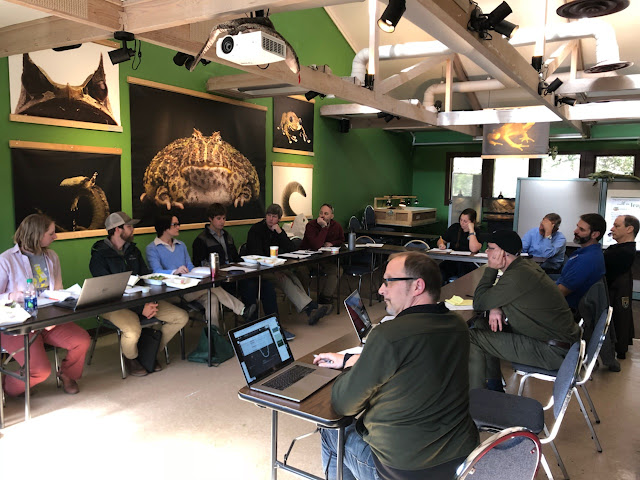
Today was the annual Georgia Gopher Frog Research and Conservation Summit . This year it was hosted here in Atlanta at the Amphibian Foundation. UGA (Maerz Lab), Zoo Atlanta, GA DNR and USFWS was in attendance. In all likelihood, the captive propagation program at AF (and also at Zoo Atlanta) will not produce eggs for experimental release this season as the frogs are still a bit young. We collectively decided to focus our attention on field surveys of known and historic ponds throughout Georgia. Georgia Gopher Frog Research and Conservation Summit, Amphibian Foundation, Dec 2018.  The Amphibian Foundation has been tasked with leading field surveys at Alligator Creek WMA , about 3 hours south of Atlanta. Surveys probably will not start for weeks, but we are putting the word out to the public that we need help! If you would like to get out to the field and help us look for Georgia's rarest frog (or at least the eggs of GA's rarest frog) Please let us know. If you send...

The Amphibian Foundation joins the Striped Newt Repatriation Project!!

Image
Beautiful Fall Line Sandhills WMA (Aug 2017) We are honored and excited to be invited to contribute to the Striped Newt Repatriation Project. This collaborative effort, lead by Ryan Means of the Coastal Plains Institute is focused on the release and  monitoring of captive bred Striped Newts ( Notophthalmus perstriatus ) into protected and managed habitat in the southeastern coastal plain. This season, the Amphibian Foundation and the Detroit Zoo join Jacksonville Zoo, Memphis Zoo, Central Florida Zoo and Lowry Park Zoo in maintaining captive breeding populations of the 3 remaining populations of Striped Newts. AF staff went into the field with Ryan, John Jensen from Georgia Department of Natural Resources and Pierson Hill from Florida Fish and Wildlife at Fall Line Sandhills Wildlife Management Area to collect wild Stripe Newt larvae. The goal was to collect 25 larvae in order to establish captive breeding colonies at the foundation and Detroit Zoo ... the mission ...