Posts

Showing posts with the label plethodontidae

#AtlSciFest Amphibian Walk @ Clyde Shepherd Nature Preserve!
Image
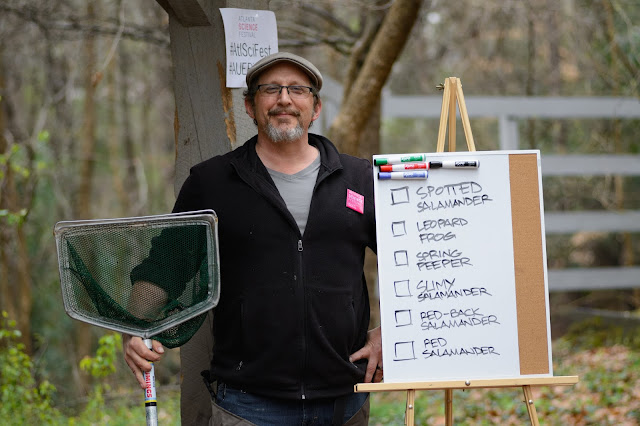
As part of the Atlanta Science Festival, the Amphibian Foundation and Blue Heron Nature Preserve put on an Amphibian Walk at CSNP in Decatur. This is one of our favorite amphibian spots in the metro area and we weren't disappointed! It rained that morning so turnout was actually pretty light, but that made it a more intimate event — AtlSciFest Volunteers including Photographer Craig Colsky and the foundation head out and found lots and lots of amphibians. (Photos by Craig Colsky) Mark Mandica, Executive Director of The Amphibian Foundation stands next to an ambitious list of amphibians we were hoping to see on our amphibian walk. Mark explaining the dynamics of an ephemeral wetland A Spotted Salamander ( Ambystoma maculatum) egg mass Crystal Mandica, Co-founder of The Amphibian Foundation holding a Spotted Salamander egg mass Southern Red-back Salamander, Plethodon serratus Daylin was very curious, but didn't want to get too close Kathy wa...

Rainy day in Atlanta. Plethodon glutinosus complex. Slimy Salamander

Image
via Instagram http://ift.tt/13MMHbN

Desmognathus conanti, Spotted Dusky Salamander. Dekalb County. MAAMP survey last night

Image
via Instagram http://ift.tt/1oeabcv

The Garden and our Amphibian Conservation Program featured on the Weather Channel

Image
On Friday, The Garden was featured on the Weather Channel's morning show AMHQ. Sam Champion, Maria LaRosa, Mike Bettes (pictured above) and Anaridis Rodriguez were here to do the show and conduct interviews with Garden staff, including me — for a moment — to talk about the Amphibian Conservation Program. To see the video, click below ... The producers wanted to have amphibians on the show, and originally requested some of our most colorful amphibians to go live on national television. I was planning on showcasing Phyllobates terribilis , a bright yellow and potentially lethal Poison Dart Frog as well as Cruziohyla calcarifer , one of the larger Phyllomedusines (Leaf frogs) with brilliant yellow-orange flash coloration hidden by a leaf green dorsum. Friday morning, however, with temperatures still in the 40's, I informed them wouldn't be safe for our tropical amphibians, and substituted them with 2 of our native amphibian species. Lithobates capito , the Carolin...

Attack of the Cave Salamanders!

Image
Cave salamanders emerging from their burrows in the front of the Salamanders of Georgia display Of the six amphibian exhibits in the Conservatory lobby, the Salamanders of Georgia display contains some of the shyest animals we have ever tried to exhibit. In fact, most visitors don't believe there are eleven full-grown salamanders in there! A couple of weeks ago, during the 11 am exhibit feeding, a salamander phenomena occurred, and practically every salamander in the tank emerged and fed! Initially, they seemed to stay at their burrow entrances using their tongues to feed as crickets would pass by, but then that was abandoned for right out biting lunges at the prey (as if to not leave anything to chance). These salamanders are fed at that time several times a week, so why they chose to demonstrate their predatory prowess at that particular time — I have no idea. Fascinating though.  Luckily, a visitor was right there with the camera and was able to get some ...

Our New Salamander Exhibit!

Image
Aneides , the Green salamander The amphibian conservation program welcomes a new order of amphibians— Salamanders ! Come and check out our display of 4 species of native Georgian salamanders. These animals were all collected (with permits) by our amphibian conservation team to promote amphibian and conservation awareness—especially since salamanders face many of the same environmental threats as their frog relatives. Dante, Robert and Mark spent the day @ Pigeon Mountain (NW Georgia) looking for these elusive creatures. Talk about elusive! There are 12 salamanders in the exhibit, and although typically you can see all 12 at any given moment... it's not easy! Salamanders are usually shy animals and they have lots of places to hide. Here are some of Dante's amazing pictures so you know what you are looking for next time you are in the Fuqua Conservatory lobby!