Posts

Showing posts with the label turtles

Stuck in a Peanut Butter Jar! Snapping Turtle is rescued by AF staff and volunteers
Image
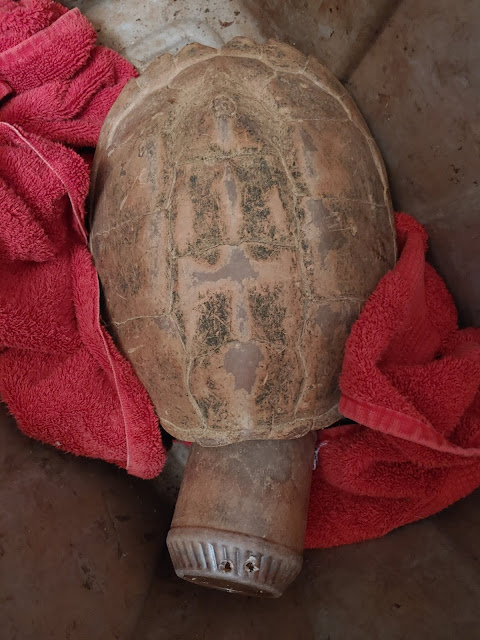
Yesterday, we received a troubling call from Carola, an Education & Outreach Volunteer at the Amphibian Foundation. She and her family found an adult Snapping Turtle ( Chelydra serpentina ) with its head stuck in a peanut butter jar. Having a lot of experience with Snapping Turtles — this is something I had never heard of! What could possibly motivate an adult Snapper to jam its head in a peanut butter jar to the point where it couldn't get it out!? Did it want some peanut butter? Did some other tasty morsel crawl in there? Nevertheless, Carola and her son's Patrick and Alan were concerned, so they contacted us. Anthony and I sprung into action. Though we had gone on many Snapping Turtle rescues, this was an unprecedented mission. What might we need to remove the Snapper's heard from the jar? I brought an oil filter wrench (maybe to grip the jar), and a small hammer (in case we needed to bust the jar). Turns out, we needed neither of those things. Her...

AF Welcomes a supreme tortoise ambassador — Lola!

Image
It took Nancy and Roger 18 years to raise Lola from a hatchling to this magnificent tortoise. At about 90 pounds, Lola still has a lot of growing to do, and Nancy & Roger felt it was time to donate him to an institution. We were happy to welcome Lola to the Amphibian Foundation, and just know that he will be loved by both our staff, and by the hundreds of kids that will be amazed by how beautiful and friendly this tortoise is! Lola was clearly raised with a lot of love, and having met quite a few adult sulcata tortoises, I can say that Lola is the friendliest I have ever met. Well I’m not the world’s most masculine man. But I know what I am and I’m glad I’m a man and so is Lola.  Lo lo lo lo  Lola - Ray Davies Nancy, Roger and Lola (Africa Spur-thigh Tortoise, Geochelone sulcata )

Turtle Conservation

Image
via Instagram http://ift.tt/2um9dHU I apologize for the long delay in between posts. We have been overwhelmed with building the Amphibian Foundation and launching a second location for our reptile and amphibian summer camp — Critter Camp! Everything has been going so incredibly well, and we are in the process of completing our newest facility, which will serve as our main research lab. We are also excited to be launching our Urban Turtle Conservation Program. Aside from our amphibian conservation programs, we work with other Atlanta-based nonprofits on #UrbanEcology, Conservation and Restoration. Last year, along with Atlanta Audubon @atlantaaudubonsociety Blue Heron Nature Preserve @bhnpatlanta Trees Atlanta @treesatlanta Chattahoochee Nature Center @sighted_on_the_127 and Arabia Mountain @arabia_alliance One of the most imperiled groups in metro Atlanta are our turtles. We are working on bringing lasting solutions to the issues which turtles face, particularly in an urban environ...

It's that time of year for Turtles Crossing the Road — Find out what you can do to help them.

Image
Young Snapping Turtle Crossing the Road. Road Mortality is a major cause for turtle declines. Here is a link from USFWS describing safe turtle helping procedures

A Grand Day with Leslie, Amphibian Specialist @ the Garden

Image
Leslie Phillips, Amphibian Keeper at the Garden, with a newly hatched Eleutherodactylus coqui  We had particularly great luck finding frogs yesterday while giving a tour of the Fuqua Conservatory to the Development Team at the Garden. The timing was perfect as a clutch of Coqui eggs was hatching right before our eyes! Coqui, and frogs of the genus Eleutherodactylus are direct developers , meaning the eggs develop directly into froglets and the tadpole stage is skipped. This allows the frogs to lay their eggs anywhere with a little moisture and there is no need for standing water. We were able to find both varieties of Red-eyed Leaf Frog, Agalychnis callidryas . The Bijagual form, with maroon eyes and orange stripes on the flanks, and the La Selva form with red eyes, and purple/blue stripes. Later that day, we went to the Atlanta History Center where we are consulting with them on constructing an ephemeral wetland on their property. We found Two-lined Salamanders (o...

Wonderful Behind-the-Scenes Tours and Collaborative Discussions Today in Amphibian Conservation

Image
I had the privilege today of meeting with two groups and talking about amphibian conservation, our program and ways to collaborate to get the word out about amphibian declines by getting our community involved! First, I met with Aaron and Cleo from #weloveatl, a native metro Atlanta social phenomenon. I met Aaron and Cleo when he and I both gave talks at the TEDx conference in April at GA Tech. I have been looking forward to meeting with them to discuss uniting the Garden and our Amphibian Conservation Program with the enthusiasm of his #weloveatl community. Aaron (one of the founders of #weloveatl) and Cleo outside of the frogPOD. I had a wonderful visit with them today. Secondly, I met with some of the Garden staff from the Advancement and Development teams, and showed them around our amphibian conservation collections. Unfortunately, we don't often get to spend time with member of other departments, and I was grateful that that took me up on my offer to show them some of...

Mata Mata skull, lateral view (Chelus fimbriatus)

Image
via Instagram http://ift.tt/1xRY8vo

Mata Mata skull, dorsal view (Chelus fimbriatus)

Image
via Instagram http://ift.tt/1BQiP9L

Mata Mata, Chelus fimbriatus - one of my favorite turtle species and first professional drawings of my career

Image
via Instagram http://ift.tt/1yMjjjW

MAAMP Frog Call Workshop and Field Trip at Arabia Mountain

Image
I was invited by Ranger Robby to give an Amphibian Identification and Frog Call Workshop at Arabia Mountain for one of their autumn events. It was a crisp day and they were pressing fresh cider at the Nature Center!  It was an excellent chance to engage with the Nature Preserve and recruit people for Metro Atlanta Amphibian Monitoring surveys. Arabia Mountain in November is very beautiful (plus there's a Stinkpot in the center of this picture!) London's sharp eyes found a Stinkpot in the water. A closeup of the Stinkpot ( Sternotherus oderatus) . The amazing staff at Arabia Mountain took me on a tour of ephemeral wetlands: London, Devin, Laurence and Ranger Robby

Stinkpot, Sternotherus oderatus on Arabia Mountain ...

Image
via Instagram http://ift.tt/110nMRx

Turtle day at summer camp was fun!

Image
via Instagram http://ift.tt/1npl2VB

Reptiles @ The Garden ...

Image
Five-lined skinks,  Plestiodon fasciatus are common throughout the Garden ... particularly the Parterre Garden Two issues of ' Clippings ' ago ... we featured Reptiles in the Rotunda — highlighting some of the reptilian species lurking in the trop house and conservatory. There are many reptile species in the conservatory. The orchid center, including the high elevation house, orchid house and atrium also provide refuge for many native and non-native reptile species. In this post we feature some of the scaly critters here as well as some of the folks that love them.... Amphibian Specialist, Leslie Philips and Conservatory Director, Ron Determann checking out some new hatchling turtles Ron inspecting Carmine, our conservatory resident Alligator Snapper , who was being weighed while we cleaned out his pond Can you spot the Oustalet's Chameleon ( Furcifer oustaleti ) in this picture? (see below) There are a bunch of them in the conservatory and they are doin...

Weighing the Conservatory's Alligator Snapping Turtle!

Image
Melissa Carlberg and her students from Beecher Hill Elementary School came, as part of their after school studies program here at The Garden, to help me weigh ' Big Carmine ' (our resident Alligator Snapping Turtle, Macrochelys temminckii ) Big Carmine lives in the largest of the seven ponds inside the rotunda, under the bridge (photos by Julia Rittenhouse). One of the Beecher Hills students helping me fasten the waders. You can see the scale in the background. The students of Beecher Hills Elementary cheering me on as I am about to enter the pond with an  Alligator  Snapping turtle Here we are -  I am demonstrating one way to safely lift and hold a large snapper We all made guesses, but Big Carmine is actually not so 'big' weighing only 26 pounds. Adults of this species can break 200 pounds!

Notes from the Field: Dante in Peru 2

Image
November is hatching time for many species of Amazonian Turtles. Chelonoidis denticulata | Yellow Foot Tortoise , Motelo  Kinosternon scorpioides | Amazon Mud Turtle  Yellow-Spotted River Turtle | Podocnemis unifilis Yellow-Spotted River Turtle | Podocnemis unifilis

Underwater amphibian photography

Image
One of the member of our frog conservation team, Danté Fenolio, is also quite a photography enthusiast. Cryptobranchus , the Hellbender Sternotherus minor , Loggerhead musk turtle Necturus , the Mudpuppy Recently, he has acquired some underwater photography equipment and what better way to test it out than to try and get photographs of the elusive Hellbender . Hellbenders are notoriously difficult to photograph due to their large size and secretive habits, preferring to live under large, relatively un-liftable rocks along fast flowing river bottoms. Photographing Hellbenders is also at minimum a two person job. One to lift the aforementioned huge rocks and one to stand ready for taking photos. Then there is the problem of how to remain still enough to take a photograph while the river's current is naturally trying to drag you downstream. Obviously, this requires great dedication and skill—but as you can see from the photos, quite worth it!

Spring in the Conservatory

Image
Male Phantasmal poison frog | Epipedobates tricolor , guarding a clutch of eggs This weekend was on the colder side, and it was pretty quiet in the mornings. Peaceful times like these are perfect to see the amphibians on exhibit and throughout the Conservatory engaging in behaviors they are too shy to exhibit when there are a lot of people around. If you ever make it to the Garden just after opening, I would suggest bringing a small flashlight (if you would like to maximize the chance of seeing some interesting amphibian activities) Rain frog | Pristimantis gaigei , in amplexus The resident quail and our Central American box turtles ( Rhinoclemmys ) sharing breakfast Our Gopher frog Head Start tadpole rearing setup Fringed leaf frog | Cruziohyla craspedopus , in amplexus 3 of the 4 Rain frogs were out all weekend, usually one can see zero   Inside of ferns is a good place to look for Poison frogs in the Conservatory