Posts

Showing posts with the label general frog biology

Native Species Spotlight: Lithobates sylvaticus | Wood Frog

Image
An amazing photo of a female Wood Frog by my new friend, Lisa Powers. Females are generally reddish in color, particularly during their breeding season. One of the first signs of spring — or at least the ones I look for — are the Wood Frogs. Where I am from in Massachusetts, Wood Frogs brave the ice and snow to make it to their vernal ponds to breed every year. I can recall many times when I am out at night in the spring—freezing! ... and these little frogs aren't complaining (and they can't even produce their own body heat!) — they are just making their way to the breeding site. In Georgia, the Wood Frogs are out right now, calling and laying eggs in ephemeral pools (and occasionally the edges of permanent wetlands) Wood Frogs typically lay all their eggs in one place, so if you find one clutch, you have probably found them all. When laid, they are about the size and shape of a tennis ball or baseball, but quickly swell up with water and become much larger. Here is a ...

A Wonderful documentary exploring a year in an ephemeral wetland: Metamorphosis: Amphibian Nature Documentary

Image

Ask the frog staff: How many tadpoles actually survive into adulthood?

Image
Hi Mark. A frog friend and I were at the lily pond today and it was rife with tadpoles of various sizes and stages. Two questions: 1) It looked like the two ducks might be feeding on them ... do they? 2) How many tadpoles actually survive to frog adulthood? — Christine C. This particular topic has come up a lot recently, and one of our visitors beautifully photographed a heron eating a rather large bullfrog out of the lily pond in the Children's Garden . It was a graphic interaction, but demonstrates how vital amphibians are in food webs and one of the reasons we use to illustrate how important it is to keep amphibians around. Almost everything eats them, or their tadpoles, or their eggs ... or all three.  Many animals eat frogs exclusively (including some frog species!), and the herons at the Garden obviously love them. I have seen ducks eating tadpoles quite rapidly. In fact, my amphibian class last summer quantified how quickly different aquatic birds could ...

Reunited with students from Duke TIP!

Image
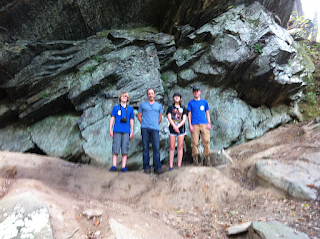
Me and 3/13ths of my talented students from this summer's amphibian biology and ecology course AKA 'puddle class'. Pictured here at Chattahoochie River Wildlife Management Area (CRWMA) This past weekend, three of my students from the Duke University TIP's ' Frogs, Bogs and Pollywogs - Amphibian Biology and Conservation ' class came to visit, learn more about our amphibian conservation program, and potentially develop internships to continue honing their field ecology skills. The three week course, which was half biology, half ephemeral wetland ecology and all amphibians, took place in June in Sarasota at The New College of Florida . It was just an incredible experience ( for more information see our previous blog post here ) one I was thrilled to continue here at the Garden. One of the highlights for me was my first Black rat snake ( Pantherophis obsoletus ) . Although they are relatively common throughout their range, I have never lived where they do...

Duke TIP Summer Amphibian Biology Course

Image
A Duke TIP biology student holding an Axolotl | Ambystoma mexicanum This past June, I instructed an intensive three week amphibian biology course at The New College of Florida in Sarasota. The class was offered as part of Duke University's Talent Identification Program's summer studies program. Duke TIP is a major leader in identifying academically talented students and providing innovative programs to support the development of their optimal educational potential. Months earlier, we were asked by Duke TIP to design a college level amphibian biology class, and although the class coincided with the busy amphibian reproductive season here at the Garden, we wanted to take advantage of this amazing opportunity to work with Duke TIP and these incredible students. The class sold out immediately and there was a waiting list! With careful planning and lots of help from frog volunteers and staff, we were able to send me down to instruct the course. I arrived at New College five...

Ask the Frog Staff | What do frogs do in the winter?

Image
'What do frogs do in the winter?' "Was visiting yesterday and strolled past both the "Frog Baby" pond and  the lily pond.  Where do the frogs go in the winter?  Thank you."  -  Christine C. Thank you for your question! The answer to which I find particularly fascinating. Frogs do several different things to handle freezing temperatures in the winter. Those bullfrogs in the Garden ponds ... do just what they and other frogs do in the winter which is brumate . Brumation is like hibernation, only metabolically it is a much different process utilized by cold blooded animals. Leopard frogs and Green frogs are other examples of frogs that brumate. They simply burrow, dig or hide deep enough below the frost line where they won't actually be exposed to freezing (or below) temperatures. Other frogs (at least up and down the East Coast) actually posses the biological equivalent of antifreeze in their cells so freezing temperatures ar...

Species Spotlights: Poison frogs and Glass frogs

Image
Epipedobates tricolor | Phantasmal poison frog (Morispunga morph) Male transporting tadpoles. Frogs are among the most diverse groups of vertebrates . They occur globally from the tropics to the sub-arctic regions, and in just about every conceivable habitat, one can find a frog species that has specialized to live there. Despite this diversity, it is generally easy to tell a frog from any other type of animal. Thanks, in part, to the absence of a tail like most other critters. Due to the range of unique requirements these habitats demand of frogs, each species has specialized behaviors and/or characters and some of these specializations are quite spectacular. Today, we are featuring two species which possess unique, prominent physical attributes. First, and one of the author's favorites is the Phantasmal poison frog | Epipidobates tricolor , which has been living, breeding, singing and hopping around the Fuqua Conservatory since 1995. Most poison frogs (family: dendr...