Posts

Showing posts with the label amphibian biology course

Agnes Scott Amphibian Biology Class Visits the Amphibian Foundation!

Image
The Fall 2018 Amphibian Biology Class from Agnes Scott outside of the Field Research Center at Blue Heron Nature Preserve. Here we our outside one of the mesocosms at the Amphibian Research and Conservation Center

Marbled Salamanders detected in metro Atlanta by the MAAMP and Agnes Scott Amphibian Biology Class!

Image
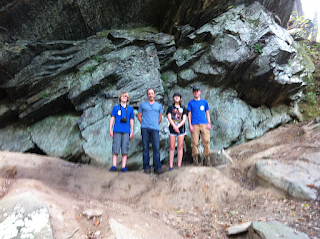
The Agnes Scott Biology of Amphibians continuing education class had an incredible field outing yesterday when we joined Metro Atlanta Amphibian Monitoring Program (MAAMP) community scientist Kate Carson at a new field site in the hopes of detecting Marbled Salamanders ( Ambystoma opacum ). Jeff, Rob, Kate, Anna, Christian and Anthony on our urban expedition to find Marbled Salamanders. Earlier in the year, The Nature Conservancy inadvertently unearthed a Marbled Salamander while removing invasive plants from the park. They reached out to us at the Amphibian Foundation and we were able to confirm this was only the second confirmed sighting of the species since the MAAMP began in 2014. Marbled Salamanders are considered 'common' throughout most if its range, but have suffered significant declines in developed and urban regions, probably due to loss of their breeding and upland habitats. Ephemeral (temporary) wetland breeding amphibians only use the wetland for a few w...

Amphibian Feeding Mechanics Class at the Garden

Image
This semester, the Garden's Department of Research and Conservation collaborated with GA Tech's School of Biology to offer a research course in aspects of  functional morphology . As one of my favorite subjects of all time, functional morphology — or biomechanics  — investigates animal movements (often with the help of x-ray and/or high-speed videography) to gain a better understanding of how animals successfully project their tongues, locomote, capture prey, swim, burrow or practically anything one can measure and sequence. The Biomechanics of Amphibian Feeding class of 2014 . From the top left: Alison Burger, Allison Miles, Emily Stephens, Rachel Whitmire, Courtney Pettiford, Erin Gish. Middle left: Paul Sanders, Leslie Phillips (Garden Teaching Assistant), Alexis Noel (GA Tech Teaching Assistant) Courtnae Ramser, Anna Morocco, Blake Christianson. Front Row: Instructors Dr David Hu and Mark Mandica The class was offered to 10 graduating seniors at GA Tech and the pu...

Ask the frog staff: How many tadpoles actually survive into adulthood?

Image
Hi Mark. A frog friend and I were at the lily pond today and it was rife with tadpoles of various sizes and stages. Two questions: 1) It looked like the two ducks might be feeding on them ... do they? 2) How many tadpoles actually survive to frog adulthood? — Christine C. This particular topic has come up a lot recently, and one of our visitors beautifully photographed a heron eating a rather large bullfrog out of the lily pond in the Children's Garden . It was a graphic interaction, but demonstrates how vital amphibians are in food webs and one of the reasons we use to illustrate how important it is to keep amphibians around. Almost everything eats them, or their tadpoles, or their eggs ... or all three.  Many animals eat frogs exclusively (including some frog species!), and the herons at the Garden obviously love them. I have seen ducks eating tadpoles quite rapidly. In fact, my amphibian class last summer quantified how quickly different aquatic birds could ...

Reunited with students from Duke TIP!

Image
Me and 3/13ths of my talented students from this summer's amphibian biology and ecology course AKA 'puddle class'. Pictured here at Chattahoochie River Wildlife Management Area (CRWMA) This past weekend, three of my students from the Duke University TIP's ' Frogs, Bogs and Pollywogs - Amphibian Biology and Conservation ' class came to visit, learn more about our amphibian conservation program, and potentially develop internships to continue honing their field ecology skills. The three week course, which was half biology, half ephemeral wetland ecology and all amphibians, took place in June in Sarasota at The New College of Florida . It was just an incredible experience ( for more information see our previous blog post here ) one I was thrilled to continue here at the Garden. One of the highlights for me was my first Black rat snake ( Pantherophis obsoletus ) . Although they are relatively common throughout their range, I have never lived where they do...

Duke TIP Summer Amphibian Biology Course

Image
A Duke TIP biology student holding an Axolotl | Ambystoma mexicanum This past June, I instructed an intensive three week amphibian biology course at The New College of Florida in Sarasota. The class was offered as part of Duke University's Talent Identification Program's summer studies program. Duke TIP is a major leader in identifying academically talented students and providing innovative programs to support the development of their optimal educational potential. Months earlier, we were asked by Duke TIP to design a college level amphibian biology class, and although the class coincided with the busy amphibian reproductive season here at the Garden, we wanted to take advantage of this amazing opportunity to work with Duke TIP and these incredible students. The class sold out immediately and there was a waiting list! With careful planning and lots of help from frog volunteers and staff, we were able to send me down to instruct the course. I arrived at New College five...