Posts

Showing posts with the label conservation

Last Steps for Metamorphosis Meadow — Gopher Frog Mesocosms!

Image
We are nearly complete with our outdoor conservation research facility — an array of 20 tri-phasic mesocosms nicknamed 'Metamorphosis Meadow' or MetaMo. Todays Task: the completion of 3 sandhill mesocosms designed for the captive breeding of Georgia's rarest frog, the Gopher Frog ( Lithobates capito ). The source populations for the 11 year assisted metamorphosis and experimental release program continue to decline, so we have teamed up with Zoo Atlanta, Georgia DNR, UGA and USFWS to establish captive breeding groups of the species. Today's Mesocosm Team (front left): Nooch, Crystal and Mark Mandica, Roberto Valencia (visiting from Ecuador) and Caleb Black; (back left) Barbara Marston, Jason Bracken, Emma Slutsker, Juan Taquechel, Joshua Black, and Dr Michael Black (top right). Kate Carson looking happy with pride over completing a Gopher Frog mesocosm. Kate was instrumental in building the Flatwoods Salamander mesocosms as well. Anthony Mandica, co-founde...

Shirts for Salamanders!!! Vote for your Favorite Salamander Design

Image
The 'Shirts for Salamanders' T-Shirt Contest is underway! Proceeds go to benefit the Flatwoods Salamander Recovery Program here at the Garden as well as Mossy Salamander Conservation at the Costa Rica Amphibian Research Center. They are all incredible designs!!! Click the link below to vote: http://epoll.me/vote/ACjHaqrVDbg/national-amphibian-expo/please-vote-for-your-favorite-design

'Shirts for Salamanders' contest to raise awareness (and funds) for Flatwoods Salamanders, among others

Image
The National Amphibian Expo has chosen to focus on supporting caudate conservation including the Garden's Frosted Flatwoods Salamander Recovery Project! “Shirts for Salamanders” is a t-shirt design contest in which the public will have an opportunity to design the front graphic which will be featured on the shirts. The National Amphibian Expo has partnered with the Amphibian Ark, the Amphibian Conservation Program here, and the Costa Rican Amphibian Research Center to create the 'Shirts for Salamanders' T-shirt contest! The contest ends August 1st.  For more information, please see the National Amphibian Expo's website here , or the Amphibian Ark's website , or the NAE's Facebook page . A big thank you goes out to the National Amphibian Expo and Amphibian Ark for making this possible! The proceeds from the shirt sales will go to supporting Flatwoods Salamander conservation as well as the conservation of Mossy Salamanders and the conservation proje...

Getting ready to release this year's batch of Gopher Frogs!

Image
Here is the Gopher Frog pond at the protected site in SW Georgia John and Erin (from UGA) and Michelle (Garden Amphibian Conservation Intern) installing the fencing so the Gopher Froglets can be monitored after release It was a particularly hot day with a heat index of 111 degrees! The ends are left open until the time of release to allow Gopher Tortoises to move freely. A view of one of the two pens installed last week.

In Honor of Ray Semlitsch — friend, colleague and collaborator

Image
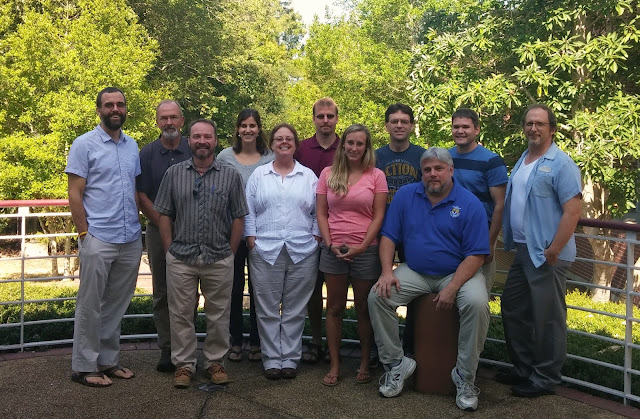
This week, the world lost a great man, scientist and amphibian conservationist — Ray Semlitsch. Ray was a prominent amphibian ecologist and advocate for amphibian conservation, particularly with salamanders. I had the honor of working with him at the Flatwoods Salamander Recovery Symposium last summer and his input into the process then, and since then was invaluable. He will be missed. It is our duty to carry the torch for Flatwoods (and other) Salamander Recovery .... The Flatwoods Salamander Recovery Team at an SDM workshop last summer in Mississippi Here is the post from the Missourian , highlighting his life and accomplishments. ------------------------------------------------------------------------------------------------------------------------- Ray Semlitsch, an MU Curators' professor of biology and an international leader in amphibian ecology, died Wednesday in Columbia. He was 64. Ray Semlitsch COURTESY OF MU NEWS BUREAU Dr. Semlitsch's research ...

2015 Haskell Award goes to GA's own John Jensen!

Image
John Jensen, state Herpetologist for GA DNR was recognized for his incredible conservation efforts this year by receiving the Haskell Award for 2015 The  Alison Haskell Award for Excellence in Herpetofaunal Conservation  is presented by Partners in Amphibian and Reptile Conservation (PARC), in memory of  Alison Haskell  (1956 – 2006). This award is intended to recognize an individual from North America who exemplifies extraordinary commitment to herpetofaunal conservation, has thus far been an unsung hero, and has shown exemplary commitment to building or strengthening partnerships. Alison was one such person.   We are proud to announce the 2015 recipient of the Alison Haskell Award is   John Jensen.  John is currently the state Herpetologist for the Georgia Department of Natural Resources. John has directly contributed to the conservation of imperiled amphibians and reptiles, in particular Gopher Frogs and Indigo Snakes, through many suc...

Optimistic about this year's Flatwoods Salamander larval season

Image

Amphibian outreach at The Friends School 2nd Grade Class

Image
via Instagram http://ift.tt/1wo8Skv

Ask the Frog Staff: Making your backyard 'amphibian friendly'

Image
I have been receiving more frequent questions about making one's backyard more amphibian friendly ... that is great! I thought I would post some ideas here. There are many compelling reasons to make your backyard 'amphibian friendly' ... one, is that natural ecotones provide refugia, or safe places for amphibians and are even easier to maintain than a well manicured lawn. There are natural and exciting ways to manage your property, that can provide much needed habitat for amphibians, particularly in an urban environment such as Atlanta. Your backyard could not only provide sanctuary for amphibians, but if enough people do the same the amphibian communities can be connected once again as they were before becoming disconnected or fragmented , by the development of roads, malls, and other forms of large paved structures. Here is a resource from the GA DNR: Georgia Wildlife website: Attracting Amphibians to Your Backyard Frogs, toads and some salamanders can be easily a...

New Documentary will feature the Garden's frogPOD

Image
Louie Psihoyos, documentary film-maker who was awarded an Oscar (best documentary) for his film 'The Cove', is completing a new documentary on the global endangered species crisis. Louie's own personal concerns for the environment are reflected in his film topics and in the founding of the Oceanic Preservation Society. The Cove brought awareness to the continued slaughter of dolphins in Taitzi Bay, which is estimated at over 20,000 dolphin/year. His next documentary will highlight the imperiled species from around the world. The amphibian component will feature our Amphibian Conservation Program and was filmed in the frogPOD. The frogPOD houses, in isolation from other amphibians, one of the rarest assemblages of amphibians — all rescued from a chytrid fungus outbreak in Central Panama in 2005. Not the most spacious of places to film, but it worked. I will be sure to post when the movie is released. Here are some pictures from the filming. Joel Sartore, Nation Geogr...

MAAMP Survey Photos from Lauren @ Paces Mill

Image
Lauren Melde, Amphibian Conservation Intern and MAAMP surveyor @ Paces Mill took these great photos of species she encountered during this month's survey. Thanks Lauren! Hyla chrysoscelis , Cope's Grey Treefrog, perched on a branch. This is a male that was heard calling during the survey. Here is the Grey Treefrog from the top ... beautiful! Southern Leopard Frog, Lithobates sphenocephala

The Garden and our Amphibian Conservation Program featured on the Weather Channel

Image
On Friday, The Garden was featured on the Weather Channel's morning show AMHQ. Sam Champion, Maria LaRosa, Mike Bettes (pictured above) and Anaridis Rodriguez were here to do the show and conduct interviews with Garden staff, including me — for a moment — to talk about the Amphibian Conservation Program. To see the video, click below ... The producers wanted to have amphibians on the show, and originally requested some of our most colorful amphibians to go live on national television. I was planning on showcasing Phyllobates terribilis , a bright yellow and potentially lethal Poison Dart Frog as well as Cruziohyla calcarifer , one of the larger Phyllomedusines (Leaf frogs) with brilliant yellow-orange flash coloration hidden by a leaf green dorsum. Friday morning, however, with temperatures still in the 40's, I informed them wouldn't be safe for our tropical amphibians, and substituted them with 2 of our native amphibian species. Lithobates capito , the Carolin...

Our Amphibian Conservation Program featured in Friday's AJC!!

Image
Elizabeth Montgomery from the AJC wrote a very nice piece on our Amphibian Conservation Program. Images and captions on the link below. Thanks, Elizabeth! Photos: The frogs at Atlanta Botanical Garden

Metro Atlanta Amphibian Monitoring Surveys begin!

Image
30 baby Spotted Salamanders ( Ambystoma maculatum ) were released in Storza Woods last year at an artificial ephemeral wetland made by amphibian conservation staff, volunteers and interns. Storza Woods is one of the many sites being monitored this field season. Pictured here is an adult female. This month, the first surveys for the Metro Atlanta Amphibian Monitoring Program began in Dekalb and Fulton Counties. Initiated by the Amphibian Conservation Program , we hope to collect data on the 17 species of frog and 14 species of salamander native to Greater Atlanta. In time, this data could provide us with vital information on the health and status of our urban amphibian communities, as well as identify potential sites for conservation and habitat restoration. Last year, amphibian conservation staff, volunteers and interns built an artificial ephemeral wetland inside of Storza Woods (the north west corner of the Garden) and released almost 30 baby Spotted Salamanders ( Ambystoma ...

SEPARC 2014 | Feb 13 - 16th, Lake Cumberland State Park Kentucky

Image
This is the third year I have had the opportunity to draw the graphic for the annual SEPARC (Southeast Partners in Amphibian and Reptile Conservation) Conference. 2014 is the Year of the Salamander , and this year the featured critter is the Mudpuppy , Necturus maculosus. For more information, or to register for the conference, please click here . This year, I will be giving a workshop on scientifically illustrating reptiles and amphibians geared towards the not necessarily so artistic.

A beautiful new publication on the Conservation Status of Eurycea wallacei!

Image
Great read and wonderful photographs by Dante Fenolio , my predecessor and former Amphibian Conservation Biologist here at the Garden. The article is a free download, just click the link at the bottom. Conservation Biologist for the San Antonio Zoo, Dr. Danté Fenolio, just published a conservation assessment of a threatened salamander that lives in groundwater below the states of Georgia and Florida. The Georgia Blind Salamander, Eurycea  wallacei , spends its life in the dark, cruising around flooded caves! The paper was published in Reptiles and Amphibians Conservation and Natural History, which is a free access journal. You can download the paper at no cost, visit  http://www.ircf.org/journal/

Science Cafe/Science Tavern lecture: Indigo Snake Biology and Scientific Illustration

Image
A friend of mine (Jay Patton) snapped this photo at the beginning of the talk. On the table in front of me is a collection of specimens (skeletal and alcoholic) that I have used for illustration including this Indigo Snake book. On July 18th, I had the privilege of discussing the biology and illustration of the Eastern Indigo Snake ( Drymarchon couperi ) . This is a book, authored by Chris Jenkins of the Orianne Society, that I have been illustrating for the past few months and will most likely be published next year. Illustrating this book has givien me the rare opportunity to become intimate with indigo snake biology, ecology and conservation and I had an incredible experience sharing this information with the Science Café here at the Garden.  For more information, click below: http://www.meetup.com/AtlantaScienceTavern/events/128587622/

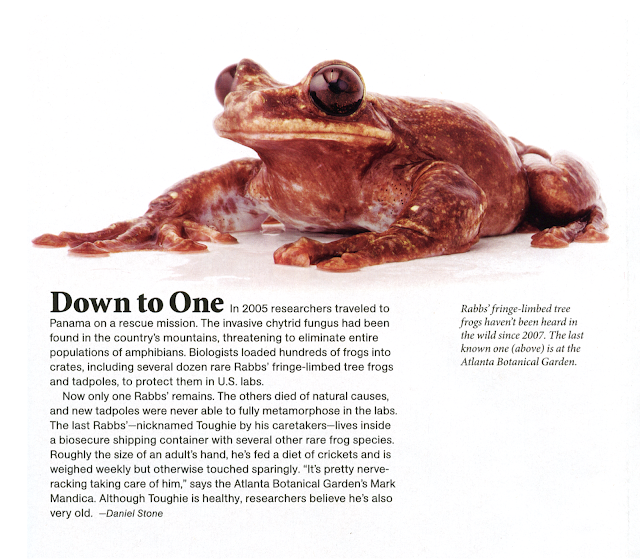
Rabb's Fringe-limbed Treefrog featured in this month's National Geographic!

Image
Thank you to Joel Sartore and Nat Geo for helping to get his story out there!

A gopher frog first! DNR nongame news Feb. 28

A gopher frog first! DNR nongame news Feb. 28

At the Gopher Frog Release Site

Image
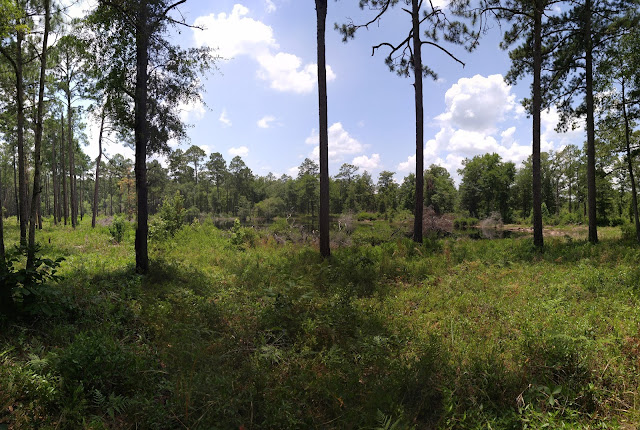
Williams Bluff. The beautiful release site of head-started Gopher frogs on protected Nature Conservancy land. This week, I had the opportunity to join Dr Maerz from UGA with Robert Hill and David Brothers from Zoo Atlanta to help sample Gopher frogs at the release site in Early County, GA. Gopher frogs ( Lithobates capito ) inhabit burrows but don't build them themselves. They 'share' underground accommodations made by Gopher tortoises, Pocket gophers and mother nature (i.e. tree stumps). It's not easy to find a frog which lives underground ... and this was my first opportunity to use a camera scope (am LED lit camera at the end of a 20' snake) so we could see down these long subterranean  burrows. We were looking for released Gopher frogs that were still making a living at the release site. Dr John Maerz (UGA)  and Robert Hill (Zoo Atlanta) sampling a Gopher tortoise burrow with the camera scope Zoo Atlanta's Robert Hill (top) and David Brot...