Posts

Showing posts with the label frog calls

Phenomenal Audio Recording of Gopher Frogs this Season in Alabama

Recording by Mark Bailey — Here is the caption from Mark's post: Recorded 01-15-2020 at an isolated wetland in Conecuh National Forest, AL . Heard are Gopher Frog ( Lithobates capito ), Southern Leopard Frog ( Lithobates utricularia ), Ornate Chorus Frog ( Pseudacris ornata ), Spring Peeper ( Pseudacris crucifer ), and Southern Chorus Frog ( Pseudacris nigrita ).

Some incredible methods and interesting methodology on sonic surveys from the Measey Lab

Image
To read the article, click here

An on-line nature sounds resource from around the world — Nature Sound Map!

Image
Nature Sound Map — Nature sounds, professionally recorded from around the world! An amazing resource Click here to visit Nature Sound Map

Beautiful Toad Audio from the master, Lang Elliot

http://musicofnature.com/toads-at-dawn/?mc_cid=3dd168c5f3&mc_eid=e5c6faa94f

A new recording of the last known Rabbs' Fringe Limbed Tree Frog calling!

Keith Hughes, an intern in the Amphibian Conservation Program was able to make a spectacular recording of our Rabbs' Fringe Limbed Tree Frog. This recording includes him 'warming up' to sing. He brought the recording over today to my studio where we mixed it down and edited our background noise, other frog calls, etc ... We were both very happy with how it came out. He is still going strong! This is a big deal because he has only been heard once or twice before in the 10 years he has been in captivity, and he is believed to be the last Rabbs' Fringe Limbed Tree Frog on earth. For more frog calls from rare and endangered amphibians, please see: soundcloud.com/amphibian-conservation

The Rabbs' Fringe-Limbed Tree Frog called again ... after years ... and we recorded it!

Image
The advertisement call of the last known Rabbs' Fringe-Limbed Tree Frog in captivity at the Atlanta Botanical Garden . This Panamanian species is believed to be extinct in the wild due to the emergent infectious amphibian disease chytridiomycosis , and hasn't been detected in the wild since 2007.

MAAMP Frog Call Workshop and Field Trip at Arabia Mountain

Image
I was invited by Ranger Robby to give an Amphibian Identification and Frog Call Workshop at Arabia Mountain for one of their autumn events. It was a crisp day and they were pressing fresh cider at the Nature Center!  It was an excellent chance to engage with the Nature Preserve and recruit people for Metro Atlanta Amphibian Monitoring surveys. Arabia Mountain in November is very beautiful (plus there's a Stinkpot in the center of this picture!) London's sharp eyes found a Stinkpot in the water. A closeup of the Stinkpot ( Sternotherus oderatus) . The amazing staff at Arabia Mountain took me on a tour of ephemeral wetlands: London, Devin, Laurence and Ranger Robby

Eleutherodactylus johnstonei | Whisting tree frog calling

As mentioned in the previous post, there was a low pressure system moving through central Georgia this weekend and the frogs responded. I was delighted to see and hear all 3 species of Eleutherodactylus (direct developing) frogs in the conservatory today: the Coqui | Eleutherodactylus coqui , the Whistling tree frog | E. johnstonei and the Greenhouse frog | E. planirostis . Here is a video clip of a Whistling tree frog calling in the conservatory. Frogs of the genus Eleutherodactylus are direct developing, which means they do not have a free swimming larval stage (tadpole) as most frogs do. Eggs are laid in moist places such as bromeliad axils and tiny frogs emerge from the eggs once development is complete.

This weekend at the Garden ...

Image
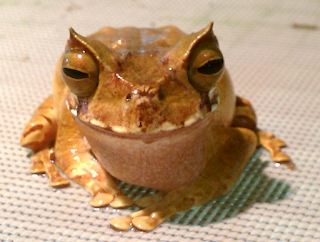
As things continue to warm up here in Atlanta, even the neotropical frogs in our captive breeding program are responding to the warmer temperatures and longer daylight hours. With all this increased activity, I was happy to have my camera with me ... I was even able to record one of our male Gastrotheca cornuta  (Horned marsupial frogs) calling! One of four calling male Gastrotheca in the frogPOD yesterday Epipedobates spp. — a possible hybrid in the Rotunda.  Pictured above is a poison frog in the Conservatory. Edward and I have had our eyes on this one for several weeks now, and we think it is possibly a hybrid between the 2 Epipedobates species living in the 'Gardens Under Glass'. E. tricolor (Phantasmal poison frog) is brown with bright green stripes on the flanks and green dorsum, whereas E. anthonyi (no common name) is burgundy red with 3 baby blue stripes down the back. The frog pictured above appears to be a 'washed out' burgundy red with ...