Posts

Showing posts with the label Epipedobates tricolor

An amazing and generous donation from Alan Grosse of the GA Aquarium

Image
Moments after we finished painting our new research lab last Sunday, Alan came with an extremely generous donation of three heavily planted and beautiful terraria. On the left is Morispunga Epipedobates tricolor , next are two varieties of Oophaga pumilio , and on the right is Ranitomeya benedicta — three different genera of tiny Poison Frogs! Thanks Alan!!!

#‎Phantasmal‬ ‪#‎PoisonFrog‬ Epipedobates tricolor in the ‪#‎FuquaConservatory‬

Image
via Instagram http://ift.tt/2aSn5UQ One of the first things (and ultimately one of my favorite things) about the conservatory is this healthy and vital population of ‪#‎Morispunga‬ tricolors. One can observe them in this semi-natural setting 365 days a year, but they are most active during the mornings after the conservatory has been watered heavily. Look to see if the pathway is wet - if so then you should have no trouble hearing the calls of advertising male frogs, trying to woo females. If you look hard enough, you can find male frogs guarding the eggs, which are often deposited on the horizontal portion of leaves within a couple of feet from the ground. Once the eggs hatch, he will carry them on his back to one of the 7 little wetlands inside the conservatory. This atypical parental care behavior is actually common in the family of Poison Frogs -‪#‎Dendrobatidae‬ ‪ #‎Epipedobatestricolor‬ ‪#‎AmphibianConservation‬‪#‎AmphibianConservationProgram‬ ‪#‎FrogsNeedOurHelp‬‪#‎Salama...

Phantasmal Poison Frog, Epipedobates tricolor from #Ecuador.

Image
This is the most conspicuous species of the four which live free-range in the Fuqua Conservatory. Their calls permeate the tropical rotunda during the day, and with enough patience you can often spot them transporting their eggs from the deposition site to the water.

Parental care in Epipedobates tricolor, the Phantasmal Poison Frog. Tadpole transport to the puddle

Image

Epipedobates tricolor, the Phantasmal Poison Frog from Ecuador in the Conservatory

Image
via Instagram http://ift.tt/1BMpvYJ

Field Guide to the Amphibians and Reptiles of the Conservatory

Image
Finally! A guide to all the amazing animals in the Fuqua Conservatory and Orchid Center . There are many species of frog, lizard, turtle and bird and they are all included in this soft-cover field guide. You can download a PDF for free here .

Kelsey Jordan Exit Show, featuring frogs from our Conservation Collection!

Image
Kelsey Jordan , an intern in the Garden's Department of Conservation Research and student at the University of Georgia held her exit show this past Monday at  The Lamar Dodd School of Art . Kelsey is completing the scientific illustration program at UGA and her exhibit featured water color paintings as well as pencil sketches of frog species from the Atlanta Botanical Garden's amphibian conservation program. Her work highlights the unique parental care adaptations of the frog species she selected. Kelsey and I on either side of her  Rhinoderma  painting. Darwin's frogs exhibit one of the more bizarre strategies of parental care. As illustrated here, froglets emerge post-development from the mouth of their father! In this species, a male will snatch up the larvae in his mouth as they hatch. He protects them in his vocal sac until development is complete. I had the privilege of working with her at the onset of her thesis, and was amazed at her preliminary sketche...

Fuqua Conservatory Lobby Amphibian Exhibits

Image
A conservatory at a botanical garden might be an odd place to look for amphibians, but that is exactly what you will find in the Fuqua Conservatory here at the Garden. Especially in the lobby where 6 exhibits highlighting our amphibian conservation program are located. What you will see upon entering the Conservatory from the Great Lawn.  The Frogs of Costa Rica , and beyond is the hallway to our Salamanders of Georgia exhibit, where the walls display images and information about off-exhibit amphibian species we are working with that are endangered or otherwise too sensitive to be on public display. The design and development of the triple exhibit (Panama, Amazon and Costa Rica) was my first project as Amphibian Conservation Coordinator and highlights the relationships between the endemic amphibians and plants of the regions. They have been growing in nicely since January! Opposite the Panama, Amazon and Costa Rica exhibits are Poison frogs from Suriname (left) and ...

Georgia Public Broadcasting episode featuring the amphibians of GA, ABG and Robert Hill

Species Spotlights: Poison frogs and Glass frogs

Image
Epipedobates tricolor | Phantasmal poison frog (Morispunga morph) Male transporting tadpoles. Frogs are among the most diverse groups of vertebrates . They occur globally from the tropics to the sub-arctic regions, and in just about every conceivable habitat, one can find a frog species that has specialized to live there. Despite this diversity, it is generally easy to tell a frog from any other type of animal. Thanks, in part, to the absence of a tail like most other critters. Due to the range of unique requirements these habitats demand of frogs, each species has specialized behaviors and/or characters and some of these specializations are quite spectacular. Today, we are featuring two species which possess unique, prominent physical attributes. First, and one of the author's favorites is the Phantasmal poison frog | Epipidobates tricolor , which has been living, breeding, singing and hopping around the Fuqua Conservatory since 1995. Most poison frogs (family: dendr...

Spring in the Conservatory

Image
Male Phantasmal poison frog | Epipedobates tricolor , guarding a clutch of eggs This weekend was on the colder side, and it was pretty quiet in the mornings. Peaceful times like these are perfect to see the amphibians on exhibit and throughout the Conservatory engaging in behaviors they are too shy to exhibit when there are a lot of people around. If you ever make it to the Garden just after opening, I would suggest bringing a small flashlight (if you would like to maximize the chance of seeing some interesting amphibian activities) Rain frog | Pristimantis gaigei , in amplexus The resident quail and our Central American box turtles ( Rhinoclemmys ) sharing breakfast Our Gopher frog Head Start tadpole rearing setup Fringed leaf frog | Cruziohyla craspedopus , in amplexus 3 of the 4 Rain frogs were out all weekend, usually one can see zero   Inside of ferns is a good place to look for Poison frogs in the Conservatory

Photos from our visitors

Image
Epipedobates tricolor transporting 6 tadpoles to water in the conservatory Since the blog started, we have been inviting the Garden's visitors to contribute photos to share. Well, here is our first visitor submission! An amazing photograph by Kyle Finn (Moody Gardens) of and adult  Epipedobates tricolo r (Phantasmal poison frog) transporting tadpoles across the conservatory on its back!

Species Spotlight: Phantasmal Poison frog

Image
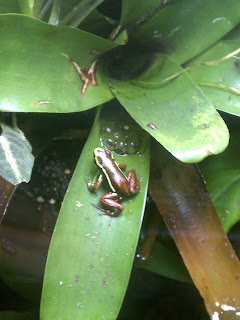
One of the things that Edward (one of our volunteers) and I love to do on Sundays is look for frogs throughout the Conservatory, usually while we are trying to round up all 4 Ornate Wood Turtles ( Rhinoclemmys ) to make sure they get a nice veggie breakfast. One or two of the wood turtles can typically be found basking on the rocks towards the front of the rotunda, but it can be challenging to find all 4!   Here is a juvenile Epipidobates tricolor we found in the Conservatory yesterday. Usually, the juvenile phantasmal poison frogs we find aren't as colorful as this one sitting in Edward's hand. It normally takes these frogs a few months to acquire this dramatic adult coloration—which might signify that the frog is becoming ready to breed.       Can you spot the poison frog in this picture? We have blown it up on the right to help. About 30 frogs were released into the Conservatory in the mid-90's and they are still thriving here today! One typically has to go...