Posts

Showing posts with the label Amazon

Re-issue of expired Care2 Article by Tex Dworkin and Mark Mandica
Image
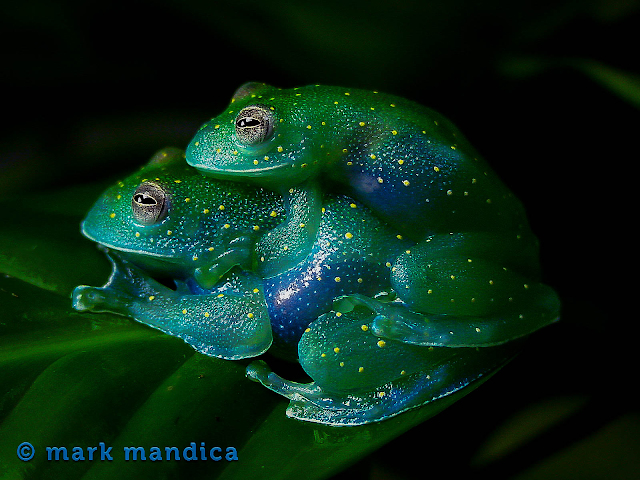
The article that my dear friend Tex and I worked on 4 years ago is no longer accessible on the Care2 site where it was published. I thought I would post it here, as it provided a wonderful opportunity to connect with conservation minded folks, who were not necessarily aware of the global amphibian extinction crisis. You can still find remnants of the original article on Pintrest. Plus, it was the first time I ever had my cell phone photography featured in a publication. It's a very nice piece, and brought a lot of attention to amphibians. I thought, given all that has been happening with quarantines and COVID-19, it would be a good time to share some of my favorite frog pictures.  Some of the language has been updated --------- Meet 10 Stunning Frogs Whose Populations are Dwindling Slope Snouted Glass Frog , Cochranella euknemos Conservation Status: Decreasing Glass Frogs (family Centrolenidae) are so named due to the translucent skin on their bellies. This al...

Mimic Poison Frog, Ranitomeya imitator on exhibit in Frogs of the Amazon

Image

Mimic Poison Frog, Ranitomeya imitator on exhibit

Image
via Instagram http://ift.tt/1zf2z4O

Cruziohyla craspedopus, Fringed Leaf Frog

Image
via Instagram http://ift.tt/1nlmgfU

Our Amphibian Conservation Program featured in Friday's AJC!!

Image
Elizabeth Montgomery from the AJC wrote a very nice piece on our Amphibian Conservation Program. Images and captions on the link below. Thanks, Elizabeth! Photos: The frogs at Atlanta Botanical Garden

Species Highlight: Captive Breeding of Fringed Leaf Frogs

Image
Adult female on exhibit  Baby Fringed Leaf Frogs are so cute. These guys are growing fast! Two pairs of Cruziohyla craspedopus in amplexus The colors show up nice on the purple leaf ... Three pairs of Fringed Leaf Frogs in amplexus, and a clutch on new eggs on the leaf below the group on the right. This setup follows, as closely as possible, the suggestions of Erik Anderson.

Long awaited success with Fringed leaf frogs!

Image
The Fringed leaf frog, Cruziohyla craspedopus is one of our most popular and captivating exhibit animals In a long-term collaboration with @Mark Pepper and Understory Enterprises, the amphibian team at the Atlanta Botanical Garden has bred the Amazonian Fringe-limbed Leaf Frog ( Cruziohyla craspedopus ). I’m proud of my amphibian team for sticking with this project through countless difficult twists and turns. Nice to get results! - Dante Fenolio Fringed leaf frogs in amplexus in the rainchamber The eggs of Cruziohyla craspedopus are blue, which is not unusual with phyllomedusine frogs.  Here you can see development beginning. A few days later, the embryos, with gill filaments are clearly visible Just after hatching. Notice the large fin fold. Pigmentation has started. The robust tadpoles are much darker than they were at hatching. 

Fuqua Conservatory Lobby Amphibian Exhibits

Image
A conservatory at a botanical garden might be an odd place to look for amphibians, but that is exactly what you will find in the Fuqua Conservatory here at the Garden. Especially in the lobby where 6 exhibits highlighting our amphibian conservation program are located. What you will see upon entering the Conservatory from the Great Lawn.  The Frogs of Costa Rica , and beyond is the hallway to our Salamanders of Georgia exhibit, where the walls display images and information about off-exhibit amphibian species we are working with that are endangered or otherwise too sensitive to be on public display. The design and development of the triple exhibit (Panama, Amazon and Costa Rica) was my first project as Amphibian Conservation Coordinator and highlights the relationships between the endemic amphibians and plants of the regions. They have been growing in nicely since January! Opposite the Panama, Amazon and Costa Rica exhibits are Poison frogs from Suriname (left) and ...

It's great to be back!

Image
It has been a busy summer here in the amphibian program. For me, it was hard to be gone for the entire month of June, and then again for another week last week at IHS. The Costa Rica exhibit. This picture illustrates the differential leaf side preference of the two resident species of Tree frog. Lemur frogs typically sleep on the underside of leaves, whereas glass frogs will stick to the tops. Here are some recent pictures of some of the frogs I missed so much while I was gone, many of which are currently in breeding groups for the summer... Incilius conifera (Bufo conifera) | Green spiny toad in the Panama exhibit Splendid leaf frog | Cruziohyla calcarifer in the Colombia exhibit. One of our newest additions, the Green and black poison frog | Dendrobates auratus The Green and black poison frogs were shy at first, but now you can usually see at least a few of the five at any point in the day. Here they are in a 'coconut hut' placed in there to enco...