Posts

Showing posts with the label Epipedobates

#‎Phantasmal‬ ‪#‎PoisonFrog‬ Epipedobates tricolor in the ‪#‎FuquaConservatory‬

Image
via Instagram http://ift.tt/2aSn5UQ One of the first things (and ultimately one of my favorite things) about the conservatory is this healthy and vital population of ‪#‎Morispunga‬ tricolors. One can observe them in this semi-natural setting 365 days a year, but they are most active during the mornings after the conservatory has been watered heavily. Look to see if the pathway is wet - if so then you should have no trouble hearing the calls of advertising male frogs, trying to woo females. If you look hard enough, you can find male frogs guarding the eggs, which are often deposited on the horizontal portion of leaves within a couple of feet from the ground. Once the eggs hatch, he will carry them on his back to one of the 7 little wetlands inside the conservatory. This atypical parental care behavior is actually common in the family of Poison Frogs -‪#‎Dendrobatidae‬ ‪ #‎Epipedobatestricolor‬ ‪#‎AmphibianConservation‬‪#‎AmphibianConservationProgram‬ ‪#‎FrogsNeedOurHelp‬‪#‎Salama...

Parental care in Epipedobates tricolor, the Phantasmal Poison Frog. Tadpole transport to the puddle

Image

Field Guide to the Amphibians and Reptiles of the Conservatory

Image
Finally! A guide to all the amazing animals in the Fuqua Conservatory and Orchid Center . There are many species of frog, lizard, turtle and bird and they are all included in this soft-cover field guide. You can download a PDF for free here .

Fuqua Conservatory Lobby Amphibian Exhibits

Image
A conservatory at a botanical garden might be an odd place to look for amphibians, but that is exactly what you will find in the Fuqua Conservatory here at the Garden. Especially in the lobby where 6 exhibits highlighting our amphibian conservation program are located. What you will see upon entering the Conservatory from the Great Lawn.  The Frogs of Costa Rica , and beyond is the hallway to our Salamanders of Georgia exhibit, where the walls display images and information about off-exhibit amphibian species we are working with that are endangered or otherwise too sensitive to be on public display. The design and development of the triple exhibit (Panama, Amazon and Costa Rica) was my first project as Amphibian Conservation Coordinator and highlights the relationships between the endemic amphibians and plants of the regions. They have been growing in nicely since January! Opposite the Panama, Amazon and Costa Rica exhibits are Poison frogs from Suriname (left) and ...

This weekend at the Garden ...

Image
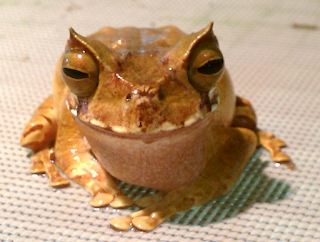
As things continue to warm up here in Atlanta, even the neotropical frogs in our captive breeding program are responding to the warmer temperatures and longer daylight hours. With all this increased activity, I was happy to have my camera with me ... I was even able to record one of our male Gastrotheca cornuta  (Horned marsupial frogs) calling! One of four calling male Gastrotheca in the frogPOD yesterday Epipedobates spp. — a possible hybrid in the Rotunda.  Pictured above is a poison frog in the Conservatory. Edward and I have had our eyes on this one for several weeks now, and we think it is possibly a hybrid between the 2 Epipedobates species living in the 'Gardens Under Glass'. E. tricolor (Phantasmal poison frog) is brown with bright green stripes on the flanks and green dorsum, whereas E. anthonyi (no common name) is burgundy red with 3 baby blue stripes down the back. The frog pictured above appears to be a 'washed out' burgundy red with ...