Posts

Inside the New Exhibits | part 2 — Costa Rica

Image
The 'new' frog exhibits: Frogs and Plants of Panama (left), the Amazon (center) and Costa Rica (right) as they look in May 2012 (this post has been back-dated) (Continued from Part 1) I started with the  Costa Rica  exhibit — the first exhibit one sees as they approach. Dante and I decided to try three tricky (shy) species all in the same exhibit:  Glass frogs  ( Cochranella granulosa ),  Lemur frogs  ( Agalychnis lemur ) and  Green and black poison frogs  ( Dendrobates auratus ). We had never tried to display either Glass frogs or Lemur frogs before, despite having worked with both groups for many years at the Garden. I have to imagine this is because they are nocturnal and extremely shy. Glass frogs, for instance, are not only shy, but are transparent! Terrible qualities for selecting an animal to exhibit. Lemur frogs are also challenging as during the day they disappear, seemingly adhered to the underside of leaves. Even Green and bl...
Healing Hellbenders

Healing Hellbenders

Inside the New Exhibits | part 1 — plants

Image
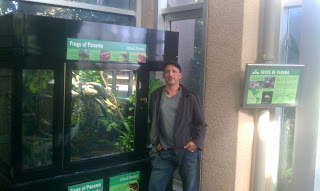
The original Frogs of Panama exhibit One of the first assignments in my new role was to design and coordinate the opening of three new frog exhibits for the Fuqua Conservatory lobby. The stand and the 3 aquaria were already being built to replace the current Frogs of the Panama Cloud Forest exhibit. This enormous terrarium (pictured with me, above) was one of the original orchid exhibits, and was showing signs it could not contain a miniature cloud forest much longer. I was delighted to hear that Robert Hill (my predecessor) and Mike Wenzel (plant records guru) had already made some headway into finding plants that would not only be accurate to the regions of which they were depicting, but might also feature plants of focus in our conservatory and conservation collections. We decided the regions we would focus on for the new exhibits would be Costa Rica , the Amazon basin, and of course a downscaled version of our previous Panama exhibit. To be honest, in previous terrariu...

Yesterday in the Colombia exhibit!

Image
Mint terribilis transporting tadpoles

Notes from the Field: Dante in Chile, Nov 2011

Image
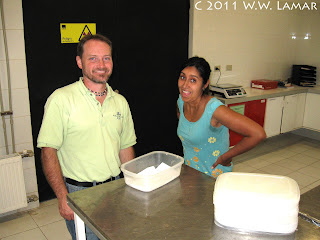
  Lead veterinarian for the National Zoo of Chile in Santiago, Marcela Tirado , and amphibian biologist for the Atlanta Botanical Garden, Danté Fenolio , prepare to process an incoming batch of live frogs going into quarantine. Skin swabs are taken from newly collected frogs as they are entered into the quarantine process at the National Zoo of Chile. Skin swabs are non-invasive and screen for a potentially lethal fungal pathogen, amphibian chytrid fungus. This Darwin's Frog ( Rhinoderma darwinii ) is tolerating a brief skin swab. Newly collected and incoming frogs pass through a quarantine process that lasts a little longer than a week.  They live in plastic boxes throughout the quarantine window.  Frog boxes are changed for sterile boxes and are given a daily soak in a solution that kills amphibian chytrid fungus.  The procedures performed ensure that frogs entering the captive breeding facility are free of amphibian chytrid fungus.

Did this frog even wake up?

I am trying to count how many things this frog can do simultaneously including sleep. The spectacular Fringed leaf frog | Cruziohyla craspedopus  are canopy frogs from the Amazon, which rarely (if ever) even come down from the tree tops. They will make their public debut in our new exhibit coming mid-January. I love how she grasps the cricket in her hand and stuffs it in her mouth ... a behavior this species shares with the other Cruziohyla — calcarifer .

Notes from the Field: Dante in Peru 2

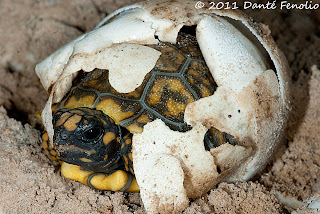
Image
November is hatching time for many species of Amazonian Turtles. Chelonoidis denticulata | Yellow Foot Tortoise , Motelo  Kinosternon scorpioides | Amazon Mud Turtle  Yellow-Spotted River Turtle | Podocnemis unifilis Yellow-Spotted River Turtle | Podocnemis unifilis